No products in the cart.
What does it mean to help every single student at school? What happens if you feel unsafe or hurt at work? Can a teaching assistant refuse to work with a violent child? These are big, heavy questions that many support workers think about every single day.
Teaching assistants act as the true backbone of our classrooms. They calm busy rooms and gently care for children who are having a hard time. But what happens when you feel scared? Your safety matters just as much as anyone else’s.
Moreover, this guide will show you exactly how UK laws protect you at school.
What does the UK law say about your safety at school?
The law in the UK says that your school must keep you safe and happy when you are doing your job.
Here is how the law protects you, broken down step-by-step:
The Big Law (Your school looks after you)
To start with, there is a big law called the Health and Safety at Work Act. This law means your bosses and the people who run the school must make sure your workplace is safe. For example, if a child is being hurtful or dangerous and the school does nothing to stop it, they are breaking this law.
Checking for Danger (Making a safety plan)
Following that, because of a rule made in 1999, the school must check for anything that could hurt you. If a pupil is known to get very angry or aggressive, the school leaders must write a special plan. This plan lists what makes the child upset and explains exactly how to keep you and the other children safe.
Your Safety Net (Walking away from danger)
At last, there is a very special rule called Section 44. This law says that if you feel you are in serious and immediate danger, you have the right to leave that room or area to stay safe. Crucially, the school cannot punish you or get you into trouble for walking away to protect yourself.
Can a teaching assistant refuse to work with a violent child?
Yes, a teaching assistant can refuse to work with a violent child if they are in serious danger.
When you wonder if a teaching assistant can refuse to work with a violent child, you must understand the difference between everyday bad behaviour and real danger. Is the pupil just disrupting the class, or are they a danger right now?
However, schools expect support staff to handle everyday things like shouting, refusing to work, or minor emotional outbursts. Moreover, these standard expectations change completely when a child throws furniture, punches, bites, or uses weapons.
Because of this, you can refuse to work with a pupil under these specific circumstances:
- You lack the correct training: You should never have to physically hold a child without proper instruction. Therefore, if the school asks you to manage a highly aggressive pupil but fails to give you positive handling training, like Team Teach, you can refuse. Without this training, you could easily injure the child or yourself.
- The task sits outside your job description: Your employment contract outlines your specific duties. So, if your school asks you to do intensive, high-risk behaviour management that your contract does not cover, you have a solid ground for refusal.
- The school ignores the risk assessment: If your school creates a safety risk assessment but fails to provide the safety measures you need, you face unnecessary danger. For example, if the document states you need two members of staff to support a child, but the school leaves you alone with them, you can legally refuse to continue until the school provides the second adult.
What are the main triggers for pupil violence in classrooms?
Yes, the main triggers are gaps in SEND support, sensory overload, communication barriers, and post-pandemic challenges.
Understanding these triggers helps in managing violent pupils in UK schools while keeping a focus on empathy for both the staff member and the child, such as:
Special Educational Needs and Disabilities (SEND) support gaps
A massive lack of funding across the UK education sector means many pupils do not receive the specialised support they need. Therefore, when a child waits months for an official assessment or misses out on an Education, Health and Care Plan (EHCP), they often express their frustration through physical means.
Sensory overload
Many neurodivergent pupils, including children with autism or ADHD, experience severe sensory distress in a busy classroom. Because of this, bright lights, loud noises, and crowded spaces can cause a total emotional meltdown, which can look like deliberate violence.
Communication barriers
When a child cannot express their fears, confusion, or physical pain through words, they sometimes use their bodies to communicate. So, a sudden lash-out often represents a desperate cry for help from a child who feels completely overwhelmed.
Post-pandemic challenges
Recent data shows a sharp rise in challenging behaviour in primary and secondary schools since the pandemic. This is because many children missed vital early socialisation opportunities which left them with poor emotional regulation skills.
How do you report an assault or physical injury at work?
If a pupil attacks you at work, you must act fast to protect your health and your career. Writing down exactly what happened gives you the proof you need if you want to refuse to teach that child later on.
Here are the steps you should follow:
At first, you need to fill out your school’s online tracking system, like CPOMS or Arbour. You should do this right away so you do not forget anything. When you write, only share the facts and avoid using emotional words. Make sure to explain what happened before, during, and after the attack.
Secondly, ask your manager to write down your injuries in the official school accident book. Every school must keep one of these books for injuries at work. Even if you only have a tiny scratch or a bruise, it must go in this book because it provides proof if you need legal help or union support later.
After that, check if your school needs to report the attack to the government. If your injury is very bad, or if it keeps you off work for more than seven days, the school must tell the Health and Safety Executive (HSE). This is required by a law called RIDDOR. You should ask your school manager for proof that they sent this report.
In the end, you must go to see your doctor or visit a minor injuries unit straight away. Request that the doctor write a note about your physical injuries and any stress caused by the attack. This medical note is important because it proves that the attack at work harmed your health.
What support do major UK trade unions offer support staff?
You never have to face scary situations at school by yourself. When you join a trade union, you get help from legal experts and kind helpers who know exactly how to fix safety problems in the classroom.
Take a look at the table below:
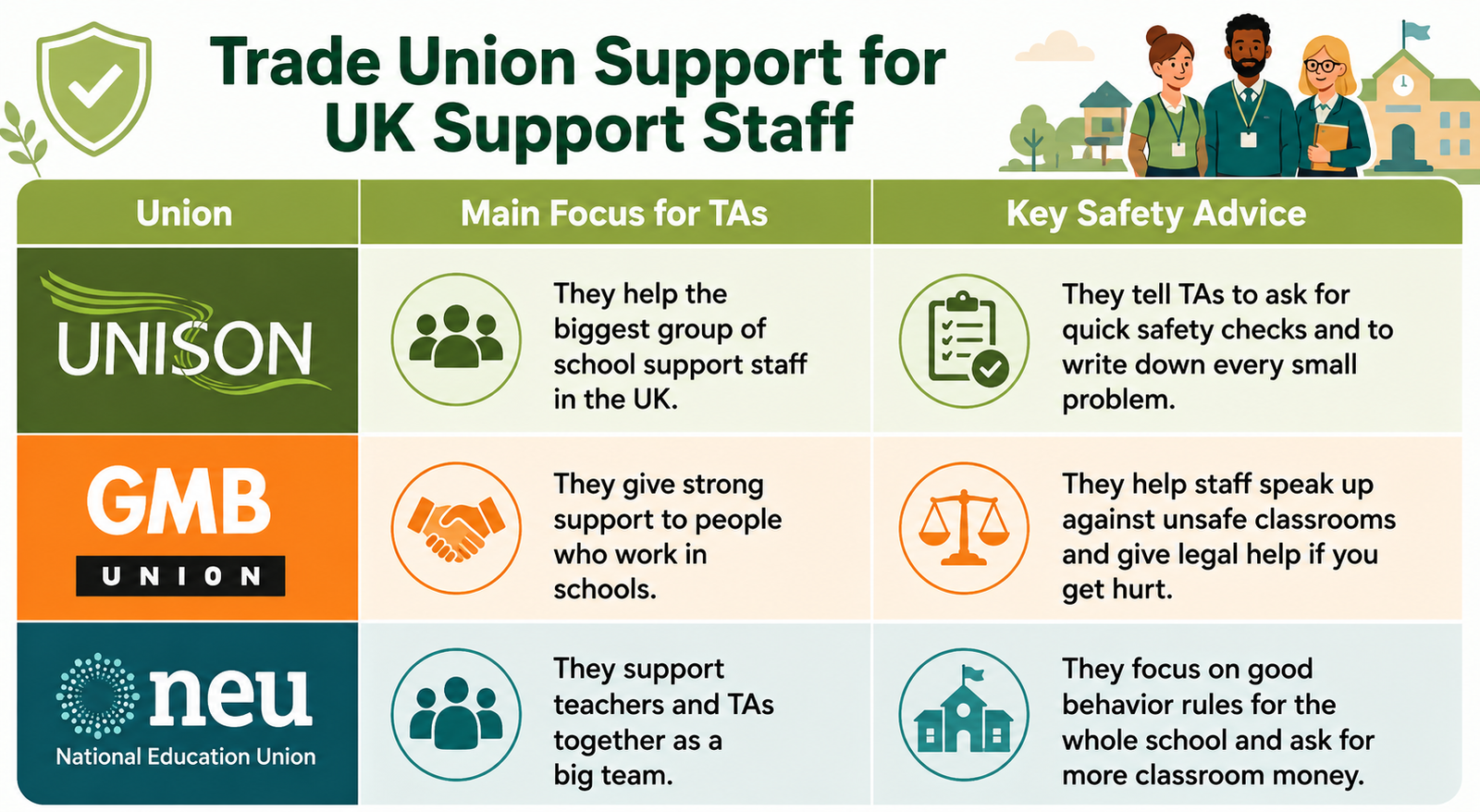
When you follow the UNISON guidelines for teaching assistants, you learn the right way to report big worries. Because of this, if you ever feel unsafe, you should talk to your local union helper at school straight away. They will go to meetings with your headteacher to stand by your side.
Furthermore, they will help you write formal letters and make sure the school listens to you carefully. Recent union reports show that many TAs face tricky behaviour every week, so your union will always understand your feelings and help you stay safe.
Final thoughts
Perhaps the truest act of support lies not in endless giving but in knowing when to stop, knowing when your hands are tired, when your voice shakes, and when your care needs care. Only then can the heart keep beating strong, not just for others, but for itself.
So, can a teaching assistant refuse to work with a violent child? The answer is yes, because your safety matters just as much as anyone else’s. While you always want to help, you must protect yourself too. Therefore, always remember to speak to your school leaders, talk to your union, and write down what happens.
Get clear on the Teaching Assistant role with our blog, then boost your career with our Teaching Assistant online course at Wise Campus!
FAQs
What should teaching assistants not do?
Teaching assistants must not lead classes permanently, administer discipline without policies, or diagnose learning difficulties.
How to discipline a child who is violent?
De-escalate calmly, remove other pupils, use positive handling training, and follow school behaviour procedures.
What is the 1265 rule in teaching?
It limits a UK school teacher’s directed work time to 1265 hours per year.
Is a teaching assistant a safeguarding role?
Yes, teaching assistants have a legal duty to spot signs of abuse and report concerns.
How to deal with a violent child in school?
Stay calm, maintain safe physical distance, ensure peer safety, and call for senior leadership support.
What are the 4 types of aggressive behavior?
The four types include physical aggression, verbal aggression, relational aggression, and passive-aggressive behaviour.
Is aggression a symptom of ADHD?
Aggression is not a direct symptom, but impulsivity and low frustration tolerance can cause outbursts.
What 6 word phrase stops passive-aggressive behavior?
Use the phrase: Please speak to me directly instead.
What are the five warning signs of aggression?
Clenched fists, pacing, raised voice, tense body posture, and prolonged direct eye contact.

Teaching Assistant Training
Course Description :
- Certificate: Yes(Free)
- Accreditation: CPD Accredited
- Access: Lifetime