No products in the cart.
What is HACCP and what are the 7 principles of HACCP? HACCP is a structured food safety system designed to identify hazards and stop them from affecting customers. It covers biological, chemical, physical and allergenic risks throughout food preparation and production.
To manage these risks properly, HACCP follows seven clear principles. They cover hazard analysis, critical control points, critical limits, monitoring, corrective action, verification and record keeping. These principles show businesses where risks can occur, what limits to set and what action to take when something goes wrong.
But how does each principle work in practice? Now, let’s see what each of the seven HACCP principles means and how they work in practice.
What Is HACCP in Simple Terms?
HACCP stands for Hazard Analysis and Critical Control Point. It is a food safety system that helps businesses find possible hazards and control them before food becomes unsafe. The system looks at each stage of food handling, from receiving ingredients to preparing, cooking, storing and serving food. It helps businesses identify biological, chemical, physical and allergenic hazards. Staff can then set controls to reduce these risks.
HACCP also includes checking important control points, setting safe limits and recording results. If something goes wrong, staff can take action quickly. In simple terms, HACCP helps businesses prevent food safety problems before they reach customers.
What are the 7 Principles of HACCP?
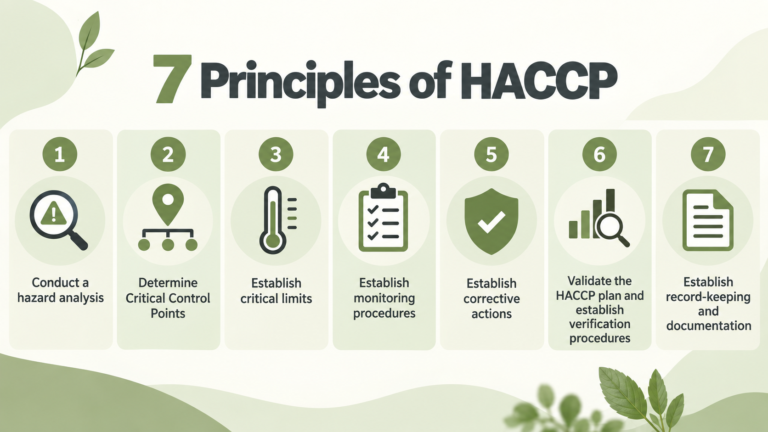
The 7 principles of HACCP are a step-by-step system for controlling food safety hazards. They help businesses identify risks, decide where control is essential and check that those controls work. The seven principles are:
- Conduct a hazard analysis
- Determine Critical Control Points
- Establish critical limits
- Establish monitoring procedures
- Establish corrective actions
- Validate the HACCP plan and establish verification procedures
- Establish record-keeping and documentation
The HACCP principles connect hazard analysis, CCP control, monitoring, corrective action and verification into one system.
Principle 1: Conduct a Hazard Analysis
Principle 1 means identifying possible food safety hazards at every stage of the food process. Businesses then assess which hazards could cause significant harm and decide how to control them. A hazard analysis should consider:
- Biological hazards: harmful bacteria, viruses or other microorganisms capable of contaminating food and causing illness.
- Chemical hazards: cleaning products, pesticides or unwanted residues entering food during handling or production.
- Physical hazards: foreign materials like glass, metal or plastic pieces accidentally entering food during production.
- Allergenic hazards: allergens entering food through cross-contact during preparation, handling or production.
Businesses should also consider whether a hazard could already be present, enter during processing, grow or survive. Then, they assess each hazard by looking at its likelihood and severity. Likelihood means how likely the hazard is to occur. Severity means how serious the harm could be. This helps the HACCP team decide which hazards are significant and need stronger control.
For example, raw chicken may contain harmful bacteria. Cooking can act as a control measure because enough heat can reduce that hazard to a safe level. The aim is not to list every possible risk. Businesses should focus on hazards that need proper control.
Principle 2: Determine Critical Control Points
A Critical Control Point, or CCP, is a stage where control is essential for food safety. If control fails at a CCP, a significant hazard may remain or reach an unsafe level. Businesses therefore need to identify which stages require strict control. Common examples are:
- Cooking food to destroy harmful bacteria
- Chilling food quickly enough to limit bacterial growth
- Detecting metal before packaged food leaves production
Not every control becomes a CCP. Businesses can use a HACCP decision tree, technical knowledge and professional judgement to identify the correct points. They should also record why a stage was chosen as a CCP. This creates clear evidence behind the decision.
Principle 3: Establish Critical Limits
A critical limit is the measurable boundary between acceptable and unacceptable control at a CCP. Critical limits tell staff exactly when a process remains safe and when action becomes necessary. Critical limits may cover:
- Temperature
- Time
- pH
- Water activity
- Moisture level
- Other measurable safety conditions
For example, a cooking CCP may have a minimum temperature and time requirement. Businesses can also set a target value that is stricter than the critical limit. This gives staff time to make adjustments before the actual safety limit is breached.
Critical limits should be validated using reliable scientific, legal or technical evidence. This helps confirm that the chosen limit can control the food safety hazard effectively.
Principle 4: Establish Monitoring Procedures
Monitoring means regularly checking whether a CCP stays within its critical limits. A clear monitoring procedure should answer five questions:
- What needs checking?
- How will staff check it?
- When will they check it?
- Who will carry out the check?
- Where will the result be recorded?
For example, staff may use a calibrated probe thermometer to check food temperatures. Monitoring may happen continuously or at planned intervals. The frequency should allow staff to detect problems before unsafe food moves further through the process.
Records should show the actual result rather than simply saying that everything was satisfactory. Staff responsible for monitoring should also know what action to take when a limit is missed.
Principle 5: Establish Corrective Actions
Corrective action explains what staff must do when a CCP falls outside its critical limit. A good corrective action should deal with both the food and the cause of the problem. Staff may need to:
- Bring the process back under control
- Hold or isolate affected food
- Reprocess food when it is safe to do so
- Dispose of unsafe food when necessary
- Find out why the failure happened
- Prevent the same problem from happening again
For example, if cooked food does not reach the required temperature, staff may continue cooking it until the safe limit is reached.
There is also a difference between missing a target and breaching a critical limit. Missing a target may give staff time to adjust the process. Breaching a critical limit means the business must assess both the process and any affected food. Businesses should record the problem, action taken and final decision about the affected food.
Principle 6: Validate the HACCP Plan and Establish Verification Procedures
Principle 6 checks whether the HACCP plan can control hazards and whether the system works as intended. This principle has three connected parts:
- Validation checks whether the chosen controls can actually control the identified hazards.
- Verification checks whether staff follow the HACCP plan and whether the controls work correctly.
- Review checks whether the plan still matches the business, food and processes.
Validation should normally take place before the HACCP plan is fully used. It may rely on scientific studies, legal requirements, technical guidance or recognised industry standards.
Businesses should also validate the plan again when important changes affect food safety. These changes may involve ingredients, equipment, recipes, processes or production methods. Verification can use several methods:
- Record reviews
- Internal audits
- Equipment calibration
- Staff observations
- Sampling and testing where suitable
- Checks after changes to ingredients, equipment or processes
For example, a business may validate a cooking process using scientific evidence. It can then verify the process by reviewing cooking records and checking thermometer calibration. This principle makes sure the HACCP plan works in real conditions, not only on paper.
Principle 7: Establish Record-Keeping and Documentation
Principle 7 requires businesses to keep suitable HACCP documents and records. These records provide evidence that hazards have been identified and food safety controls are being followed. Useful HACCP records are:
- Hazard analysis documents
- CCP decisions
- Critical limits and supporting evidence
- Monitoring results
- Corrective action records
- Verification and validation records
- Staff training records
- HACCP review records
Records should be clear, accurate and easy to access when needed. Businesses should also control document versions. Staff need to work from the current HACCP plan rather than an outdated copy. How long records should be kept depends on the business, product and process. Product shelf life may also affect the retention period.
Overall, the 7 principles of HACCP create a complete food safety control system. They help businesses identify significant hazards, control risks at critical stages and respond when something goes wrong. They also provide evidence that food safety procedures are working properly.
What Is the History of the 7 Principles of HACCP?
HACCP began in the early 1960s when NASA needed a safer way to prepare food for astronauts. NASA and Pillsbury developed a system that focused on preventing hazards during food production. Instead of only testing finished food, they looked for risks at each stage and controlled them early.
Over time, HACCP moved from space food into the wider food industry. Several important milestones shaped the system we use today:
- 1971: Pillsbury publicly presented HACCP at a major food protection conference.
- 1973: HACCP ideas began influencing US rules for low-acid canned foods.
- 1985: The National Academy of Sciences recommended HACCP for controlling food safety risks.
- 1989: NACMCF published detailed HACCP guidance.
- 1992: NACMCF revised the system and clearly set out the seven principles of HACCP.
- 1993: Codex Alimentarius adopted international HACCP guidelines.
- 1997: Codex and NACMCF updated their HACCP guidance again.
- 1995 onwards: HACCP-based food safety controls became part of UK food hygiene law.
The seven principles were therefore developed over many years. They did not appear in their current form during the original NASA work. Today, food businesses use them to identify hazards, set controls, monitor risks and take action before unsafe food reaches customers.
What Should Businesses Do Before Using HACCP?
Businesses need to prepare properly before they start using HACCP. Good food safety practices should already be in place. The workplace should have clean premises, suitable equipment and good hygiene. The business should also manage pests, waste and suppliers. Then, the team can build a clear HACCP plan.
- Set up good hygiene practices: Keep premises and equipment clean. Manage cleaning, pests, waste and personal hygiene.
- Make sure facilities are suitable: Provide suitable equipment, storage areas and working conditions for safe food handling.
- Train and support staff: Give workers suitable food safety training. Managers should also support the HACCP process.
- Choose the HACCP team: Select people who understand the food, workplace and production process.
- Describe the food process: Record the food, ingredients, intended use and each step involved in making or handling it.
- Create and check the flow diagram: Map every process step and check it at the workplace. Make sure the diagram matches the actual process.
How Does HACCP Work With an FSMS?
HACCP works as one part of a wider Food Safety Management System (FSMS). The FSMS covers the full way a business manages food safety. HACCP focuses more closely on significant hazards that need specific control during food production or handling.
Before HACCP can work properly, businesses need basic food safety controls in place. These are known as prerequisite programmes. They cover areas such as cleaning, personal hygiene, pest control, equipment, premises and safe food handling. These controls manage everyday risks across the workplace.
The HACCP plan then deals with hazards that need closer control. It identifies Critical Control Points, sets critical limits and explains how staff should monitor them. It also sets out what staff should do when a control fails.
So, the FSMS manages food safety as a whole while HACCP gives businesses a structured way to control significant hazards within that system.
What Does UK Food Law Say About HACCP?
UK food businesses must put in place, use and maintain food safety procedures based on HACCP principles. Article 5 of Regulation (EC) 852/2004 sets out this legal requirement and links it directly to the seven HACCP principles.
However, every food business does not need the same HACCP system. The approach should match the food, processes, hazards and size of the business. A manufacturer may need a detailed HACCP plan. A smaller restaurant, café or similar business may use a simpler FSA system where suitable.
The Food Standards Agency provides tools to make this easier:
- MyHACCP helps mainly small UK food manufacturers create a HACCP-based food safety management system.
- Safer Food, Better Business (SFBB) can offer a simpler approach for many smaller food businesses.
- HACCP records should show how the business identifies hazards, controls risks and checks that its system works.
So, UK food law requires HACCP-based food safety procedures but the system should remain practical and suitable for the individual business.
How Often Should a HACCP Plan Be Reviewed?
A HACCP plan should not become a one-time document. Businesses should review it regularly to keep it useful. An annual review is a good example. However, important changes can also require an earlier review.
- Equipment: Review the plan after changing important equipment.
- Building layout: Check the plan after changes to the work area.
- Food and menus: Review new ingredients, recipes or menus.
- Staff and processes: Check the plan after staffing or process changes.
- Rules and risks: Review changes in laws, best practice or emerging pathogens.
- Daily work: Make sure the plan matches how staff actually work.
Final Thoughts on What are the 7 Principles of HACCP
The 7 principles of HACCP give businesses a clear way to keep food safe. But what are the 7 principles of HACCP really about? They help businesses find hazards, control them and check that controls work. If something goes wrong, staff can act quickly and fix it.
HACCP focuses on preventing problems before they affect food. Each business should shape its plan around its own work. Good hygiene and cleaning also support the plan. Keeping everything clear and practical makes food safety easier to manage every day.
Ready to understand what are the 7 principles of HACCP and use them with confidence? Build your knowledge with our HACCP Training Course.
FAQs
1. How to explain HACCP in an interview?
- Explain HACCP as a food safety system that finds and controls hazards. Mention its seven principles and how they help prevent food safety problems.
2. What is a HACCP checklist?
- A HACCP checklist helps staff check important food safety controls. It can cover hazards, CCPs, critical limits, monitoring and corrective actions.
3. Who is responsible for HACCP?
- The food business is responsible for having and following its HACCP system. Managers and trained staff should help maintain and check the plan.
4. What are critical limits in HACCP?
- Critical limits set the safe boundary for a CCP. Staff use them to check whether a food safety control stays within safe limits.
5. What is the HACCP cooking temperature for food?
- The cooking temperature depends on the food and the safety risk. For example, guidance often uses 75°C for 15 seconds for cooked chicken.
6. Is HACCP a legal requirement?
- UK food businesses need food safety procedures based on HACCP principles. The exact approach depends on the business, its food processes and its risks.

HACCP Training Course
Course Description :
- Certificate: Yes(Free)
- Accreditation: CPD Accredited
- Access: Lifetime