No products in the cart.
Becoming an environmental health officer takes more than finishing a course. If you want to know how to become an environmental health officer, there are three main routes. You can take an approved degree, postgraduate course or Level 6 degree apprenticeship. Some people also start as environmental health technicians and study while working.
However, professional study is only one part of the route. You may also need workplace practice, a portfolio and a final professional assessment. The exact path depends on where you qualify. Scotland follows a different EHO system from England, Wales and Northern Ireland. This guide explains the qualifications, training, registration, time, salary and career routes you need to know.
Now, let’s dive in and explore exactly how the UK environmental health officer route works.
What Is an Environmental Health Officer and Is an EHO the Same as an EHP?
An environmental health officer helps keep people safe from health risks. These risks may come from food, housing, workplaces or pollution. Officers inspect places, investigate complaints and check whether legal health standards are met.
You may also see the title ‘Environmental Health Practitioner’ or EHP. In England, Wales and Northern Ireland, EHP is the main professional term. An environmental health officer, or EHO, is also widely used for the same type of work. However, Registered Environmental Health Practitioner (REnvH) is a protected professional title.
Scotland works differently. There, ‘Environmental Health Officer’ is a protected title. You must meet the Scottish professional requirements before using it.
What Does an Environmental Health Officer Actually Do?
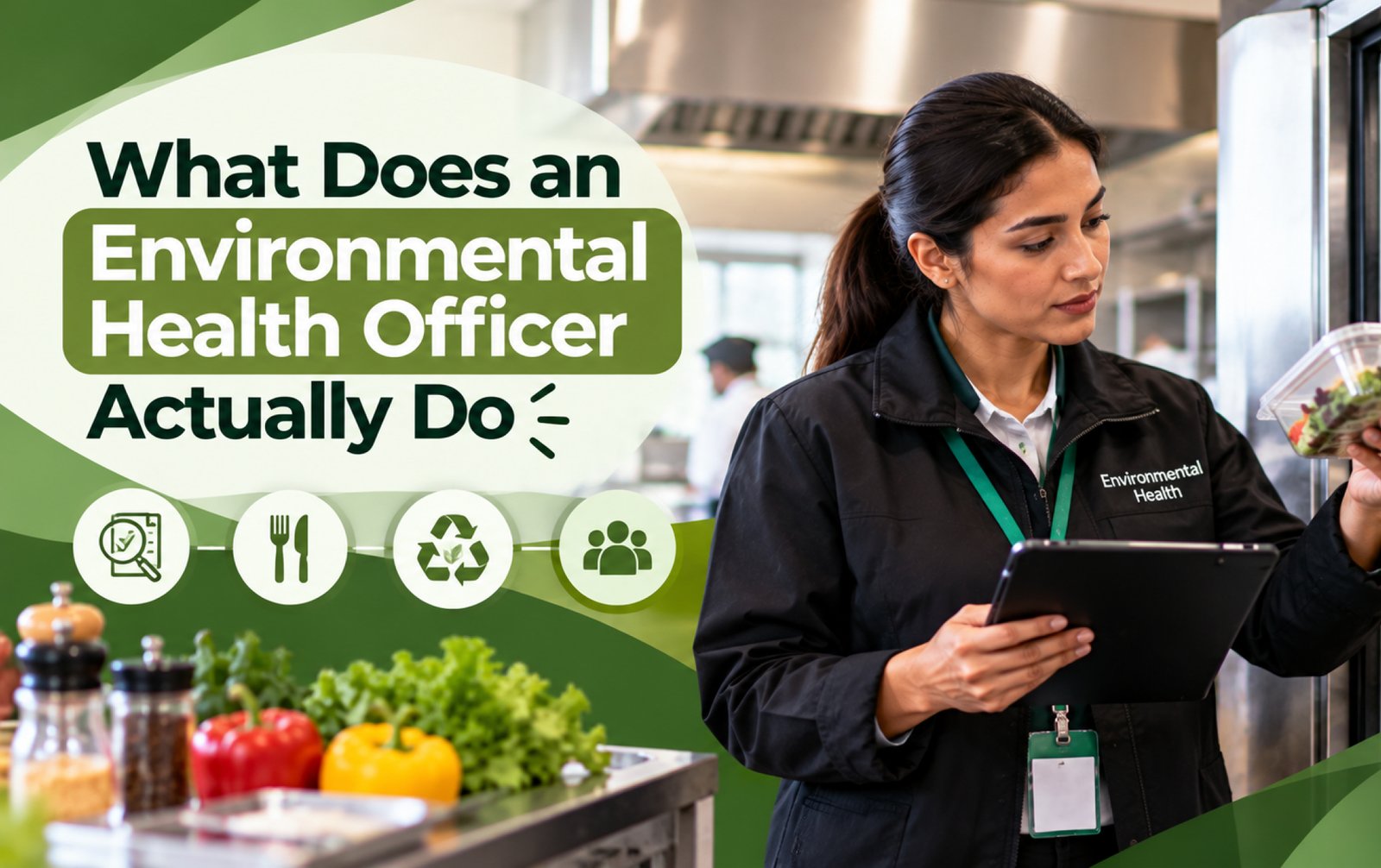
The job covers much more than restaurant checks. In practice, officers find problems, judge risks and choose an action. Some cases need advice, while others need legal action. The response depends on the risk and the law.
The main parts of the job can include:
- Investigating problems: Look into complaints, illness outbreaks and unsafe places.
- Inspecting places: Visit food sites, homes, shops and workplaces.
- Assessing risks: Decide how serious a health problem may be.
- Collecting evidence: Check records, take samples and record key facts.
- Giving advice: Explain what a business or landlord should improve.
- Taking action: Use legal powers when serious risks stay unfixed.
For example, someone reports food poisoning after eating at a restaurant. An officer visits the site, checks food controls and reviews records. They then collect the facts and decide what action is fair and needed.
Similarly, officers deal with poor housing, noise and unsafe workplaces. Some roles also cover air, water and land pollution. The exact duties depend on the employer, local area and type of case.
What Qualifications Do You Need to Become an Environmental Health Officer?
To become an environmental health officer, you usually need an approved environmental health qualification. Your best route depends on your current education and how you want to study. In the UK, the main environmental health officer qualification routes are:
- BSc degree: Often suits school or college leavers.
- MSc degree: May suit people who already hold a degree.
- Level 6 degree apprenticeship: Mixes paid work with degree study.
- Work-based entry: Some people start in support or technician roles.
For a degree, you usually need two or three A levels or equivalent. For an MSc, you need a previous degree. However, each university can set its own course requirements.
A Level 6 degree apprenticeship often needs GCSEs and A levels or equivalent. Employers and universities set the final entry rules. So, check both the course and job advert before applying.
Most importantly, check that your course supports the professional route you want. A course title alone does not confirm this. Checking before you enrol can save time, money and extra study later.
How to Become an Environmental Health Officer Step by Step?
The process is easier when you follow it in order. England, Wales and Northern Ireland mainly use the EHP route. Scotland has its own EHO system. So, check your location before choosing a course.
Step 1: Check Which UK Route Applies
Start with the country where you plan to train. Scotland uses a separate system from the rest of the UK. Your course must match the route you need. A wrong choice can add extra study later.
Step 2: Choose an Approved Course
You may choose a BSc, MSc or Level 6 apprenticeship. Your best choice depends on your past study and budget. It also depends on your work plans.
Have a degree now? An approved MSc may be a shorter route. Leaving school or college? A BSc or apprenticeship may fit better. Always check course approval before you enrol.
Step 3: Complete Your Academic Study
Your course builds the main knowledge needed for the job. You may study food safety, housing and public health. Pollution and workplace safety are also key areas.
Still, book knowledge is not enough. You must show that you can use it at work. That is why work practice matters so much. It turns study into real job skills.
Step 4: Gain Suitable Workplace Practice
You need chances to work on real cases. These may include site checks, risk reviews and case work. You also need clear proof of your work. The EHP Portfolio covers five core fields:
- Environmental protection
- Food safety
- Health and safety
- Housing and communities
- Public health
You need 13 work-based interventions across those fields. Ten are set, with two in each core field. You then choose three more from the allowed list.
You also need a work supervisor. This person helps guide your work and check your proof. Your employer may arrange time with other teams too. That helps when one team lacks enough case types. Actually, this stage can cause delays. You need access to the right type of work. Some cases may not happen often. So, plan your work practice early.
Step 5: Pass the Practical Food Identification Exam
Registered EHP status also requires a practical food identification exam. Many approved degree courses include this test. But some courses may not include it.
So what should you do? Ask the course team before your study ends. If the exam is not included, plan it early. Missing this step can hold up registration.
Step 6: Complete the EHP Portfolio
The EHP Portfolio shows how you use your learning at work. You build it with help from a work supervisor. Your employer must also support the process. You must spend at least six months on the portfolio. It should take no more than 12 months. The goal is to build real skill, not rush tasks.
In 2026, the EHP Portfolio enrolment fee is £716. This includes one professional discussion and your certificate. You also need CIEH membership during the route. Once you submit the Portfolio, the check takes about six weeks. A failed part may need another submission. Extra fees can then apply.
Step 7: Pass the Professional Discussion and Register
The professional discussion is the final EHP test. It is usually an online talk with two assessors. You discuss made-up work cases and explain your choices.
The talk lasts about one hour. Assessors look at risk, action and wider job knowledge. They want to hear why you chose each step. Once you pass, you receive a registration certificate. You also get a digital record of your status. Your name is added to the public EHP register.
Can You Become an Environmental Health Officer Without an Environmental Health Degree?
Yes, you can enter the field without already holding this degree. Some people start as environmental health technicians. They may study part-time while they work. This can help them build useful skills.
Have another degree now? An approved MSc may give you a route. Past study may also count in some cases. But each course makes its own choice.
There are also lower-level routes into some council jobs. These roles can build useful skills. But they do not replace the full EHP route. Entry is not the same as full register status.
Is an Environmental Health Officer Apprenticeship Better Than a University Degree?
Neither route is best for every person. A normal degree gives you more choice over study. An apprenticeship gives you paid work while you learn. Your own needs should guide the choice.
The current Level 6 EHP apprenticeship takes about 48 months. It mixes degree study with paid work. The current maximum training funding is £22,000.
But you need a funded job place before you start. An approved course does not mean a job is open. So, search job sites as well as course pages.
The current version accepts starts until 12 September 2027. A new version starts from 13 September 2027. If you plan a later start, check the latest rules.
How Do You Become an Environmental Health Officer in Scotland?
Scotland uses its own route for Environmental Health Officers. You need approved study, set work practice and a final exam. Do not mix this route with the EHP route elsewhere.
You must complete at least 48 weeks of set work practice. This can happen through a council or other suitable groups. Some courses may include part of this work. You must complete registration before starting your work practice. During this time, you build a work portfolio. The work must show the skills set by the Scottish scheme.
After the portfolio passes, you attend final interviews. These use work cases to test your skills. Passing leads to the Diploma in Environmental Health. This is needed to practise as an EHO in Scotland.
Have a science-based degree now? Scotland also has a route for some people. Your past study and work can be checked. But you still need to meet the set standard.
How Long Does It Take to Become an Environmental Health Officer?
There is no single time for the whole UK. The total time mainly depends on your route. It also depends on past study and work experience.
A degree route takes several years. An MSc can be shorter for a past graduate. The Level 6 apprenticeship takes about 48 months. Its final test sits outside that usual training time. The EHP Portfolio takes six to 12 months. Its check can take about six weeks. Work access can also slow you down. You need enough cases across the five core fields.
Scotland uses a separate timetable. Its set work practice needs at least 48 weeks. So, compare full career routes, not just course length.
How Much Does an Environmental Health Officer Earn in the UK?
An environmental health officer in the UK can earn about £25,000 to £75,000+ a year. Pay mainly depends on experience, location and job level. Public and private sector roles can also offer different salary ranges.
Typical earnings by career stage include:
- Trainee or graduate: Around £25,000 to £35,000 a year.
- Qualified or mid-level: Around £36,000 to £50,000 a year.
- Senior or management: Around £45,000 to £75,000+ a year.
Most qualified officers fall within the middle salary range. Senior officers, team leaders and consultants can earn more. Private firms may also offer higher pay for specialist skills.
Your location can make a difference too. Salaries often rise with experience and greater responsibility. So, check current local vacancies for the clearest picture of pay.
What Skills Matter Most in Real Environmental Health Work?
Environmental health officers need strong practical, legal and communication skills. They must assess risks, investigate problems and explain their decisions clearly. They also need to manage evidence and apply the right rules. Key environmental health officer skills include:
- Risk judgement: Decide how serious a problem may be.
- Legal understanding: Apply the right rule to each case.
- Investigation: Find facts before making a decision.
- Evidence handling: Keep records that support your findings.
- Report writing: Explain what happened and why action is needed.
- Communication: Speak clearly with residents, workers and businesses.
- Organisation: Manage several cases and deadlines at once.
- Sound judgement: Know when expert help is needed.
In practice, strong officers make fair choices and explain them. They do not just quote rules. They show why a risk matters. They also know when an expert should step in.
What Happens After You Become a Registered Environmental Health Practitioner?
Becoming a registered environmental health practitioner can open several long-term career routes. After registration, environmental health practitioners can progress into specialist, senior and leadership roles:
- Specialist work: Focus on food safety, housing, pollution or public health.
- Senior roles: Move into senior officer, principal officer or team leader posts.
- Private sector work: Join consultancies, retailers or large organisations.
- Specialist registration: Build recognised skills in food safety or housing.
- Management: Lead teams, services or environmental health projects.
- Chartered status: Work towards Chartered Environmental Health Practitioner, or CEnvH.
Chartered status shows a higher level of skill and professional judgement. It can support progression into senior and specialist roles.
Your learning also continues after registration. Keep your membership active, follow professional ethics and complete ongoing CPD.
What Should You Check Before Applying for EHO Jobs?
Before applying for environmental health officer jobs, check the practical requirements. Driving, qualifications and UK location can affect your options. These points can help you avoid problems later.
Do EHO Jobs Require a Driving Licence?
Many EHO jobs involve travel to homes, businesses and work sites. Because of this, employers often expect a full driving licence. Current UK career guidance says you are likely to need one.
However, requirements can vary by employer. Always read the job advert before applying. Some roles may accept another suitable way to travel.
Can Overseas EHO Qualifications Be Recognised?
Yes. Overseas environmental health qualifications can be assessed for UK recognition. Your past study and work experience are checked against the professional standard.
You may need extra learning or practical evidence. So, check your qualification status before applying for registered EHP roles.
Can a Scottish EHO Work Elsewhere in the UK?
Yes. A REHIS-qualified EHO can work as an EHP in England, Wales and Northern Ireland. Separate CIEH registration is available, but it is not required.
Still, individual employers can set their own job requirements. Check the vacancy details before applying.
Are EHO Apprenticeships Available Across the UK?
No. The Level 6 Environmental Health Practitioner degree apprenticeship discussed in this guide applies to England. You also need an employer-backed apprenticeship place.
So, search live apprenticeship vacancies as well as course pages. An approved course does not guarantee an available job place.
Final Thoughts: Which Route Should You Choose?
The best route depends on where you are starting from. If you are learning how to become an environmental health officer, focus on the path that fits your background, location and career goals.
A simple way to decide is:
- School or college leaver: Compare an approved BSc with a degree apprenticeship.
- Already have a degree: Check whether an approved MSc gives you a faster route.
- Already work in the sector: Look at work-based study and recognised past learning.
- Want to earn while training: Search for Level 6 apprenticeship vacancies in England.
- Based in Scotland: Follow the separate Scottish EHO qualification route.
The key is not choosing the fastest option. Choose the route that leads to the professional status you actually need. Check course approval early, then build your study and work experience around that goal.
FAQs About How to Become an Environmental Health Officer
1. What Qualifications Do I Need to Be an Environmental Health Officer in the UK?
You usually need an approved environmental health degree, an MSc or a Level 6 degree apprenticeship. Some people also start as environmental health technicians and study while working.
2. Is There a Shortage of Environmental Health Officers?
Yes. UK councils still report difficulty recruiting qualified environmental health professionals. Demand is especially strong across food safety, housing and environmental protection roles.
3. Can I Become an EHO Without a Degree?
You can enter environmental health without already having a degree. However, becoming a fully qualified EHP usually requires an approved degree, postgraduate course or degree apprenticeship.
4. What Is the Easiest NHS Job to Get?
NHS porter roles can be easier to enter because there are no set formal entry requirements. Some entry-level healthcare assistant roles also accept applicants without previous healthcare experience.
5. What Jobs Will Boom in 2026?
UK demand is strong across digital, engineering, construction, clean energy and adult social care. Skills England expects many priority occupations in these areas to keep growing over the coming years.
6. What Is a Low-Stress Job?
There is no single low-stress job for everyone. Roles with regular hours, clear duties and fewer urgent decisions often feel less stressful, depending on the person and workplace.