No products in the cart.
The difference between ASL and BSL goes beyond where they are used. It shows the culture and history of the people who use them. ASL, or American Sign Language, is used in the United States and parts of Canada. BSL, or British Sign Language, is used in the United Kingdom. Both use hands, movements, facial expressions, and body language to communicate. They do not use spoken words. Even though they are both sign languages, they are very different.
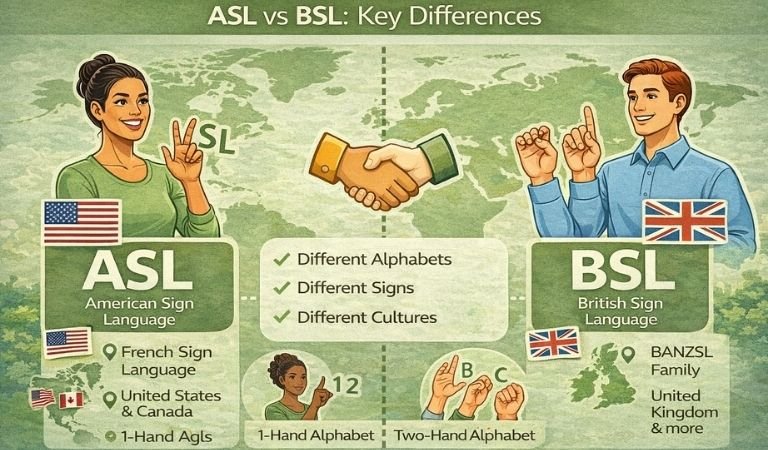
ASL comes from French Sign Language and has different versions across regions, such as Black ASL. BSL is part of the BANZSL family, which includes Australian and New Zealand sign languages. It also reflects British culture. ASL uses one hand for the alphabet, while BSL uses two hands. Vocabulary, grammar and some signs are also different. These differences show that ASL and BSL are more than languages. They tell the story of the people and communities that use them.
Let’s dive in and explore how ASL and BSL are different and what makes each one unique.
What is ASL?
ASL, or American Sign Language, is the main way Deaf and hard-of-hearing people communicate in the United States and parts of Canada. It is a visual language. Therefore, people use their hands, movements, facial expressions, and body language to share ideas, feelings, and messages.
ASL has an interesting history. It started from French Sign Language and evolved into its own unique language. It now has its own ASL grammar, vocabulary, and sentence structure. The language also has different versions in different areas. For example, Black ASL is used by the Black Deaf community and has some unique signs and expressions.
Another key feature is the structure of ASL. The ASL alphabet is used to spell names or new words. Vocabulary covers everyday words and actions. Facial expressions and body movements give extra meaning and show emotions. ASL sentences usually follow a topic-comment order. People also use space and pointing to show direction, place, or who is doing what.
What is BSL?
BSL, or British Sign Language, is the main way Deaf and hard-of-hearing people communicate in the United Kingdom. It is a visual language. People use their hands, facial expressions, body movements, and gestures to share ideas, feelings, and everyday messages.
BSL has an interesting history. It became officially recognised as a language in 2003. It is also part of the BANZSL family, which includes Australian and New Zealand sign languages. Over time, BSL has grown and changed. People in different areas or communities may use slightly different signs. This makes the language unique and full of life.
BSL has several important parts. The BSL alphabet is used to spell names or words that do not have a sign. BSL vocabulary includes signs for everyday words, objects, and actions. Facial expressions and body movements add meaning and show emotions. Classifiers, which are special hand shapes, help describe people, objects, or actions clearly.
Difference Between ASL and BSL
The difference between ASL and BSL is more than where they are used. Both are visual languages. People use hands, facial expressions, and body movements to communicate. Even though they are both sign languages, each has its own signs, rules, and ways of using the hands.
Manual Alphabet
The alphabet creates the major difference between ASL and BSL. ASL uses one hand to spell all letters. BSL is different because it uses two hands. The dominant hand points to letters on the other hand. For example, spelling “cat” looks very different in ASL and BSL.
Vocabulary
The words you sign can also be different. Americans say “cookie,” but in the UK it is “biscuit.” “Fries” in the US are “chips” in the UK. Also, some signs can change depending on the region or community.
Iconicity
Signs can show culture. ASL often copies real objects or actions. For example, the ASL sign for “coffee” shows an old coffee grinder. In BSL, some signs use handshapes to represent letters or ideas, such as the “C” handshape for drinking from a cup. This makes each language feel unique.
Grammar and Syntax
Additionally, grammar functions differently. BSL usually puts the main subject first, then the action. ASL does it differently by using space and pointing to show who does what.
Fingerspelling
ASL uses fingerspelling a lot for letters and new words. BSL mostly uses it for names or places. It also uses classifiers, which are special hand shapes to show objects or actions.
Mutual Understanding
People who know ASL and BSL cannot fully understand each other. Only about 30 per cent of the signs are the same. Because of this, history, culture, and grammar make each language special in its own way.
ASL and BSL Similarities
ASL and BSL are different languages, but they share many important features. Both are visual languages, which means people use hands, movements, and facial expressions to communicate. Thus, it makes the language clear and easy to understand even without sound.
Also, both use a topic-comment structure. You show what you are talking about first, then give more details. At the same time, facial expressions, eyebrow movements and body gestures add extra meaning. They can show feelings, describe actions, or add more detail, just like adverbs in spoken language.
Another important point is how they use space. Signers place signs around them to show direction, actions or relationships. This helps them explain even tricky ideas in a simple way.
Sign Language Diversity and International Sign
Sign languages are used worldwide. There are more than 300 sign languages, and ASL and BSL are just two of them. Every language shows the culture and history of the people who use it. Because of this, signs can look very different from one country to another, and even in different regions of the same country.
At the same time, no sign language works everywhere. People cannot use one language to talk to everyone. To help with this, there is International Sign Language (ISL). People use it at global events like the Deaflympics or World Federation of the Deaf meetings. ISL uses simple gestures and more space around the signer, so people from different countries can understand each other.
Even so, ISL is not a full language like ASL or BSL. It takes signs from many languages and focuses on gestures that everyone can recognise. This shows how special and unique each sign language is. Learning about this diversity helps us see the power of visual communication all over the world.
Learning the Difference Between ASL and BSL: ASL vs BSL
Here are some simple methods to begin learning and improving:
- Pick the right language: Learn BSL in the UK and ASL in the US so you can talk with local Deaf people.
- Use different ways to learn: Try online courses, apps, videos, or classes to practice.
- Start with the basics: Learn the alphabet and common signs first. It makes learning easier.
- Learn the culture: Understanding how Deaf people use the language helps you sign naturally.
- Practice every day: Short daily practice works better than long sessions once in a while.
- Learn both languages if you can: Knowing ASL and BSL helps you talk with more people.
- Follow a course: Take a British Sign Language course or a good ASL program to learn step by step.
- Join the community: Talk with local or online Deaf groups to practice real-life signs.
- Set small goals: Learn a few signs each week or try short conversations.
- Make it engaging: Use games, challenges or videos to stay motivated while learning.
Final Thoughts on Comparing ASL and BSL
The difference between ASL and BSL is clear when you look at their alphabet, vocabulary, grammar, and culture. For example, ASL uses one hand and reflects American culture, including specialised signs in some regions, such as Black ASL. On the other hand, BSL uses two hands, comes from the BANZSL family and shows British culture. These differences make each language special and interesting to learn.
At the same time, both languages share many features. They use hand shapes, movements, facial expressions and space to show ideas and feelings. This makes communication clear and expressive. Because of this, learning sign language helps you talk with more people, connect with Deaf communities, and include everyone. To start, watch a video, join a class, or try an online course. This way, you can see how fun and rewarding it is to communicate with your hands and face.
FAQs
-
Is it better to learn ASL or BSL?
It depends on where you live. If you are in the UK, learning BSL helps you communicate with local Deaf people. In the US, ASL is the right choice.
-
Can BSL users understand ASL?
Mostly no. While a few signs are the same, the words, grammar, and expressions are different, so full understanding is very hard.
-
What does 🤟 mean in American Sign Language?
This sign means I love you. It combines three hand shapes and is a simple way to show care or affection.
-
Does Miss Apple use BSL or Makaton?
She uses Makaton, which is a system that mixes signs with spoken words. It is designed to help children communicate more easily.
-
Should I teach a baby Makaton or BSL?
For babies, Makaton is usually better. It is simpler and focuses on helping them quickly express their needs and feelings.
-
Does the UK use ASL or BSL?
The UK uses BSL. ASL is mainly used in the United States and parts of Canada, so it is not common in the UK.
-
How do you say the f word in BSL?
BSL is about communication and respect. There is no standard sign for swearing, and it is best to focus on polite conversation.