No products in the cart.
Most people think a Realtor and a real estate agent are the same. When you first notice it, they do look similar. But the truth is different. Every Realtor is a real estate agent. But not every real estate agent is a Realtor. So, why does this difference exist? What’s the main difference between Realtor and real estate agent?
A realtor vs an estate agent mainly differ in professional standards and ethical rules. A realtor chooses to follow higher rules. They join the National Association of Realtors. They work under a strict Code of Ethics at all times. On the other hand, a real estate agent only needs a license to start working. They follow basic legal rules, but not the same extra code. Because of this, both can do similar work. However, the level of trust and responsibility is not the same.
Now, let’s dive in and explore these two roles to clearly understand the difference.
What is a Real Estate Agent? Full Meaning and Role
A real estate agent is a licensed property professional. They help people buy, sell, or rent homes and business spaces. Mainly, they work with buyers, sellers, landlords, and tenants. They listen to what people need and guide them step by step. Also, they help both sides meet and agree on a fair deal.
A real estate agent earns money through commission. They only get paid when a deal is completed. Because of this, results matter in their work. In most places, a real estate agent must work under a licensed broker. They do not work fully on their own. They also handle both houses and business properties.
Finally, a real estate agent acts as a link between the two sides. They keep the process clear, fair, and smooth from start to finish.
What is a Realtor? Meaning and NAR Membership Explained
A Realtor is a licensed property professional who works in property deals with legal permission. They also join the National Association of Realtors (NAR). This membership makes them different from other agents.
First, let’s understand NAR. The full form of NAR is the National Association of Realtors. It is a US-based organisation. It started in 1908. Today, it has over 1.5 million members around the world. NAR sets rules and standards for its members. It creates a strong Code of Ethics that all members must follow. It also provides training, market updates, and professional support.
A realtor’s main duty is to protect the client’s interest. They guide people through buying, selling, or renting property. They give honest advice at every step. This means they must work with honesty and fairness in every deal. They must always put the client first. Because of this, a realtor focuses more on trust and good professional behaviour.
Duties and Responsibilities Difference Between Realtor and Real Estate Agent
Both Realtors and real estate agents do the same main job. However, their responsibilities are not exactly the same. Here’s what both roles usually do:
Shared duties (both roles)
Both Realtors and real estate agents help buyers buy, sell, or rent property. First, they study the local market and help set fair prices. Then, they list properties and arrange viewings for buyers. After that, they negotiate deals between buyers and sellers. Next, they handle paperwork and support legal steps. Finally, they keep clients updated from start to finish.
Extra responsibilities of a Realtor
- Always follow the NAR Code of Ethics in every deal
- Stay honest and clear with clients at all times
- Put the client’s needs first in every decision
- Treat buyers, sellers, and everyone fairly
- Share any conflict of interest quickly and clearly
- Keep a higher level of trust and professional behaviour
Difference Between Realtor and Real Estate Agent (Core Comparison)
- Membership: A realtor is a member of NAR. A real estate agent works without this membership.
- Ethics rules: Realtors must follow a strict Code of Ethics. On the other hand, agents follow basic legal rules only.
- Professional identity: The title “Realtor” shows NAR membership and higher standards. Meanwhile, a real estate agent holds a standard license.
- Training support: Realtors get extra tools, training and guidance from NAR. In comparison, agents rely on state training only.
- Trust level: Realtors often gain more trust because they follow strict rules. However, estate agents can also be trusted. But trust depends on experience, behaviour, and local reputation.
- Common ground: Both earn commission. Both also use MLS to list and find properties for clients.
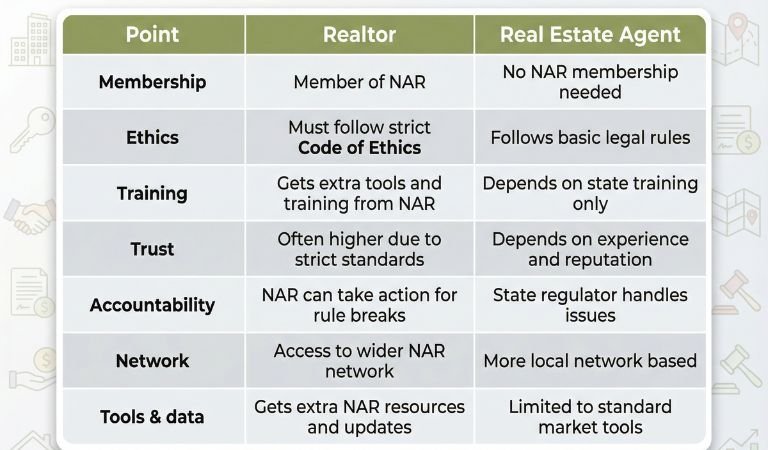
Realtor vs Real Estate Agent Licensing Requirements
Both roles start in the same way. First, you need a real estate license to work legally. To get it, you complete a pre-licensing course. Then you pass a state exam. In most areas, you also complete a background check.
Next, the process changes slightly. A realtor takes one extra step. They join the National Association of Realtors (NAR). They also need membership approval. This adds a higher professional standard.
After that, both follow the same rule. They must keep their license active to continue working. They also complete continuing education for renewal. This helps them stay updated with laws and changes in the market.
How Real Estate Agents and Realtors Get Paid
Real estate agents and Realtors make money through property deals. They do not get a fixed monthly salary in most cases. They earn only when they complete a property deal.
Next, let’s look at how much they earn. Most deals bring around 4% to 6% of the property sale price as commission. This money does not go to one person. Instead, it gets shared between the buyer’s agent, seller’s agent, and their brokers.
Because of this system, income changes every month. More deals mean more money. Higher property prices also increase earnings. So, success depends on effort, skill, and how active the market is.
Example
If a house sells for £200,000 and the commission rate is 5%, the total commission is £10,000. This amount is then split between the buyer’s agent, seller’s agent, and their brokers. Each party gets a share based on their agreement.
Code of Ethics: Realtor vs Real Estate Agent Standards
Real estate agents follow state laws. They only need to meet basic legal rules to work. On the other hand, realtors follow a higher standard. They must follow the strict Code of Ethics set by the National Association of Realtors (NAR).
This Code of Ethics is not just a guide. It works like a strict rulebook that realtors must follow all the time. It controls how they talk to clients, how they share property details, and how they handle money in deals. Even small mistakes can lead to serious action from NAR, including warnings or loss of membership. Also, this code guides how they advertise homes, handle negotiations, and share property details. As a result, every step stays clear, fair, and easy to understand.
As a result, realtors must treat clients and the public with care and respect. They also face stronger action if they break these rules.
MLS Access and Market Data Difference
MLS stands for Multiple Listing Service. It is a shared system where agents list and search properties in one place. It helps buyers and sellers move faster in the market.
Both real estate agents and realtors can use MLS. But access depends on local rules and broker approval. In most cases, agents must work under a broker to get access.
Here is something many people do not know. MLS is not open to everyone. Only licensed professionals can see full details. Public property websites often show limited or delayed information. As a result, MLS gives a speed advantage. Agents can see new listings before they go public. This helps clients make quicker decisions in a busy market.
Finally, realtors often get extra support through NAR. They also get more training, networking, and market updates beyond MLS.
Realtor vs Estate Agent Education and Training Requirements
Real estate agents start with state-approved education. First, they complete a required course. Then they pass a licensing exam to start working.
Real estate agents and realtors begin with the same basic path. But realtors go a step further. They take extra training through NAR programs. This helps them learn beyond the basic license. On top of that, both real estate agents and realtors can choose specialist training. They can study areas like commercial property, luxury homes, property management, and first-time buyers. This helps them work with different types of clients.
After that, realtors continue learning through ongoing professional development. They join workshops, training sessions, and industry updates. Some also earn optional NAR certifications to build stronger skills.
Because of this, their learning stays active and practical. It covers law, ethics, and market changes in more detail. This helps them stay confident and up to date in the market.
Cost of Becoming a Realtor vs Real Estate Agent (UK Guide)
You can start working in property without a formal license in the UK. However, training and memberships still cost money.
Firstly, a real estate agent usually starts with a property course. These courses cost around £200 to £1,000. Some employers also give free training after hiring. Next, many agents take extra courses to improve their skills. For example, Propertymark Level 3 training costs around £500 to £1,500.
After that, some professionals join groups like Propertymark (NAEA). This is similar to a realtor-style membership. The yearly fee is around £200 to £300. You may also pay extra exam or joining fees if you are not yet qualified.
Then, both roles need ongoing learning to stay updated. CPD training helps keep knowledge fresh. This usually costs around £50 to £300 per year.
As a result, starting costs stay lower for most agents. However, people who join professional bodies spend more time. In return, they often get better trust, stronger training, and more support in the industry.
Need CPD learning without high costs? Stay sharp in your skills and keep your knowledge up to date with CPD training. Join our Estate Agent Course and keep learning, simple and practical for real property work.
How to Choose Between a Realtor and a Real Estate Agent
Think about these points before you decide.
- How complex your deal is: Simple deals can work fine with an agent. Bigger or more complicated deals may need a Realtor for extra support.
- Ethical trust: Realtors follow a strict Code of Ethics. This can give you more confidence when decisions feel important or risky.
- Budget and value: Both usually earn commission, not a fixed salary. But a better experience can give you better service and results.
- Experience and local network: A strong local network can help you find better homes or buyers faster.
- Market speed and pressure: Fast markets need quick action. Good access to listings can make a big difference.
- Trust and communication: Choose someone who explains things clearly, listens well and keeps you updated at every step.
Common Misconceptions About Realtors and Agents
Let’s clear the confusion in a simple and clear way.
“They are exactly the same” → Not correct
- They do similar work, but they are not the same. Realtors also join NAR and follow extra rules.
“Realtors always earn more money” → Not true
- Income depends on deals and skills. The job title does not decide how much someone earns.
“Agents cannot be trusted” → Wrong idea
- Trust depends on the person, not the job title. Many agents are honest and helpful in their work.
“Realtor is a higher license” → False
- Realtor is not a license level. It is a membership with extra rules and standards.
Key Takeaway on the Difference Between Realtor and Real Estate Agent
Both Realtors and real estate agents help people buy and sell property. They do very similar work in daily life. However, the main difference between Realtor and real estate agent comes from membership and ethics rules. A real estate agent works with a standard license and follows basic legal rules.
On the other hand, a realtor joins NAR and follows stricter ethical standards. This means they focus more on trust, honesty, and good professional behaviour. Finally, your choice depends on your needs, your budget, and the level of trust and support you want in your property journey.
FAQs About the Difference Between Realtor and Real Estate Agent
1. Is a Realtor the same as an estate agent?
- No, they are not exactly the same. A Realtor is a real estate agent who joins NAR. They also follow extra ethical rules. An estate agent does not need this membership.
2. What’s higher than a real estate agent?
- A real estate broker is above an agent. A broker has more training and a higher license. They can also run their own agency and manage agents.
3. What is another name for a real estate agent?
- People also call them property agents or estate agents. All of them help people buy, sell, or rent property.
4. What is the highest paid type of real estate agent?
- Luxury property agents often earn the most. They deal with high-value homes and big commissions. Income also depends on skill, network, and market.
5. Who is the richest Realtor?
- There is no single official answer. Many top Realtors are very wealthy, but their income changes often. Wealth depends on deals, location, and years in the market.
6. Who are the Big 4 in real estate?
- This usually refers to the four biggest global property services firms. They are CBRE, JLL, Cushman & Wakefield, and Colliers. They work in commercial property across the world.
7. What is the rule of 7 in real estate?
- The rule of 7 means a buyer needs to see a message about 7 times before acting. In real estate, it helps with marketing and trust building. Repeated exposure helps people remember and decide.

Estate Agent Course
Course Description :
- Certificate: Yes(Free)
- Accreditation: CPD Accredited
- Access: Lifetime