No products in the cart.
Electricians play a key role in keeping homes, businesses, and factories safe by installing, maintaining, and repairing electrical systems. To start this career, you need proper training, hands-on experience, and recognised certifications, like the NVQ Level 3 Diploma and the AM2 assessment. Many people begin their journey through apprenticeships or college courses, which usually take 3 to 4 years to complete. Learning how to become a qualified electrician helps you understand the steps, gain essential skills, and prepare for industry standards. Along the way, you will build problem-solving abilities, technical knowledge, and a strong focus on safety.
This guide will walk you through the main routes and tips to succeed as a professional electrician.
What Does It Take to Become an Electrician?
Becoming a qualified electrician in the UK in 2026 takes training and real work experience. First, most people need 3–4 years to complete the path. You must finish technical courses like City & Guilds Level 2/3 diplomas, learn the 18th Edition wiring regulations, and pass the AM2 practical test. Afterwards, you can earn an ECS Gold Card.
Core Routes to Qualification (2026)
Electrical Apprenticeship (Best for 16–20s): A 3–4 year paid program. You spend 80% of your time on-site and 20% in college. This means you gain real work experience while studying. It leads to Level 3 Electrotechnical Qualification, NVQ Level 3, and the AM2 assessment.
Adult Fast-Track Training (Best for Career Changers): About 15–17 weeks of class and workshop learning, then on-site NVQ assessment. Overall, full certification takes 12–18 months.
Experienced Worker Route: For people with 5+ years of experience. Finally, you can get qualifications through an assessment-based route.
Which Courses Help You Become a Qualified Electrician?
To become a qualified electrician in the UK in 2026, you need the right training. First, you start with basic courses. Then, you move on to work-based learning. Finally, you pass a final test and get approved to work alone.
Key Courses and Qualifications for 2026
- City & Guilds 2365 Level 2 & 3 Diploma
This is the first step. It teaches basic skills and safety rules. You learn in class and do simple practical work. So, it is perfect for beginners. - Electrotechnical Qualification (5357 NVQ)
This course happens while you work. You learn on the job with real tasks. Next, you build your skills and show what you can do. - 18th Edition Wiring Regulations (BS 7671)
This course teaches the latest safety rules. You must understand these rules to work safely. Also, most employers ask for this qualification. - AM2 Assessment
This is the final test. You complete practical tasks to prove your skills. After that, you can move forward in your career. - Inspection and Testing (2391)
This course helps you test electrical systems. You learn how to find faults. In addition, it helps you get better job options. - Experienced Worker Assessment (EWA)
This is for people with work experience. If you have worked for 3–5 years, you can use this route. However, you still need to prove your skills.
Final Step: ECS Gold Card
When you finish all steps, you can apply for the ECS Gold Card. This card shows you are fully qualified. It lets you work without supervision.
Simple Path to Follow
- Start with the Level 2 and 3 Diplomas
- Then get a job or an apprenticeship
- Complete NVQ (5357)
- Take the 18th Edition course
- Pass the AM2 test
- Finally, apply for the ECS Gold Card
This path is simple and clear. If you follow each step, you can become a qualified electrician.
How Long Does It Take to Become a Qualified Electrician?
Becoming a qualified electrician takes time, but the journey feels worth it. First, most people start with an apprenticeship or an NVQ path. This usually takes around 3 to 4 years. You spend some time in class and the rest on real job sites. So, you learn theory and practical skills together.
During this time, you learn how to install wiring, fix faults, and follow safety rules. You also work with experienced electricians. This helps you build confidence step by step.
Next, if you already have experience, you can choose a fast-track option. The Experienced Worker Assessment (EWA) helps you qualify faster. This route may take a few months to a year. However, you must show strong skills and real work proof.
Also, learning does not stop after you qualify. New tools and safety rules often come. So, you take short courses to stay updated. In the end, this helps you grow and earn more in your career.
What Are the Benefits and Challenges of Being an Electrician?
Being an electrician can feel exciting and rewarding. First, there is always a demand for skilled electricians. You can find jobs in homes, offices, and big projects. Also, the pay can be good, especially as you gain experience.
Another benefit is independence. You can work for a company or start your own business. This gives you control over your time and income. So, many people enjoy the freedom this job offers.
On the other hand, the job can feel physically hard. You may stand for long hours, climb ladders, or work in small spaces. Sometimes, you work in hot, cold, or noisy places.
Also, safety risks exist if you ignore rules. Electricity can be dangerous. So, you must stay careful and follow safety steps every day.
In addition, you need to keep learning. New systems and smart technology keep changing the way we work. However, this also makes the job more interesting. Overall, if you enjoy hands-on work, the benefits often feel greater than the challenges.
What Tools and Equipment Do You Need?
Every electrician needs the right tools to work well. First, you start with basic hand tools. These include:
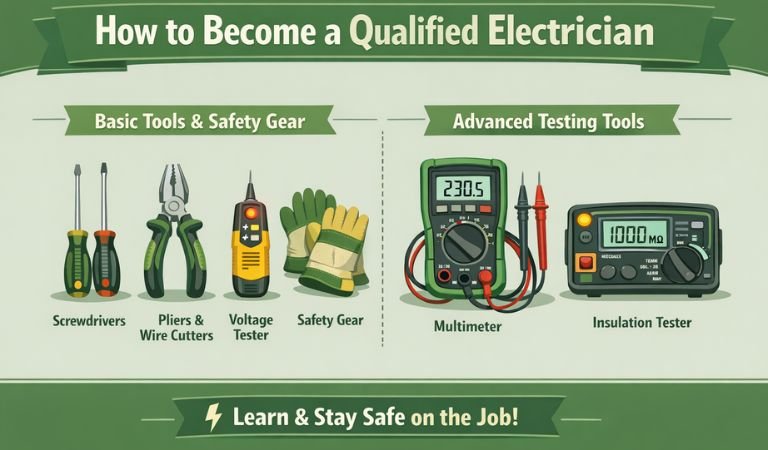
- Screwdrivers for fixing wires and sockets
- Pliers for gripping and bending wires
- Wire cutters and strippers for clean cuts
- Voltage testers to check if power is live
You also need safety gear like gloves, safety boots, and goggles. So, you protect yourself while working.
Next, you use more advanced tools as you gain experience. A multimeter helps you measure voltage, current, and resistance. This tool is very important for testing problems. Also, insulation testers help you check if wiring is safe.
In addition, many electricians now use digital tools. Wiring apps and diagrams on your phone can guide you step by step. So, you can work faster and avoid mistakes.
Sometimes, you may also use power tools like drills and cable pullers. These tools help you finish jobs quickly and with less effort. In the end, the right tools make your work easier, safer, and more enjoyable. When you feel comfortable using them, your confidence grows every day.
How to Become a Qualified Electrician
Becoming a qualified electrician takes time and effort. You need training and real work experience. Most people take about 3 to 4 years. First, you begin with the basics and build your skills step by step.
Steps to Become Qualified
- First, start with Level 2 and Level 3 Diplomas (like City & Guilds)
- Learn basic electrical skills and safety rules
- Next, take the 18th Edition wiring regulations course
- Understand UK safety standards and wiring rules
- Then, complete your NVQ Level 3 while working on-site
- Build a portfolio to show your real work skills
- After that, pass the AM2 assessment (final practical test)
- Finally, apply for the ECS Gold Card to work without supervision
Key Pathways to Qualification
- Apprenticeships
- First, this is the most common route
- You earn money while you learn
- Also, you get real job experience and college learning
- College Courses / Diplomas
- Good for adults changing careers
- In addition, you focus on basic knowledge first
- Then, you move into practical training
- Experienced Worker Assessment (EWA)
- Best for people with job experience
- However, you must prove your skills clearly
- So, you complete an assessment to qualify faster
How Important Is Health and Safety in Electrical Work?
Health and safety are very important in electrical work. You work with power every day, so small mistakes can be dangerous. First, you must always think about your safety and the safety of others. This helps you stay calm and focused.
Importance of PPE, Safe Working Practices, and UK Regulations
First, you need to wear PPE (Personal Protective Equipment). This includes gloves, safety boots, helmets, and goggles. These protect you from shocks and injuries. So, you stay safer while working.
Next, you must follow safe working steps. Always turn off the power before you touch wires. Check everything with a tester. Also, keep your tools clean and in good condition.
In addition, follow UK rules like BS 7671. These rules guide you on safe wiring and installation. So, you must understand them well.
Then, take your time while working. Do not rush. When you stay careful, you avoid mistakes.
How to Avoid Common Electrical Hazards
First, always check that the power is off. Never guess. Use a tester to be sure. After that, keep water away from electrical areas.
Also, do not use damaged wires or tools. Replace them quickly if you see a problem. However, many people ignore small faults, and this can lead to big risks.
Finally, avoid overloading sockets. Too many devices can cause heat and fire. Stay alert and work step by step.
In the end, safety is not just a rule. It becomes a daily habit. When you follow it every day, you protect yourself and build a strong and safe career.
Final Thought
Becoming a skilled electrician takes time and effort, but the rewards are great. First, you learn important skills and gain confidence while working on real projects. How to become a qualified electrician is a clear path: start with Level 2 and 3 diplomas, then take the 18th Edition wiring course, complete your NVQ, and finally pass the AM2 assessment. Along the way, you also learn to follow safety rules every day. In addition, using the right tools and wearing PPE helps you avoid risks. Overall, by following each step carefully, you can build a safe, successful, and long-lasting career as an electrician.
FAQs on How to become a qualified electrician
1. How long does it take to become a qualified electrician?
- It usually takes 3–4 years with an apprenticeship or NVQ. Fast-track routes can take 1 year or a little more if you have experience.
2. What is the fastest way to become a fully qualified electrician?
- The Experienced Worker Assessment (EWA) or short courses for adults are the quickest ways if you already know some electrical work.
3. How to become an approved electrician?
- Finish Level 3 NVQ, pass the AM2 test, and get an ECS Gold Card to work on your own.
4. Is electrician a good career?
- Yes. There is lots of work, good pay, and chances to grow, but it can be hard on your body.
5. What are 5 skills you need as an electrician?
- Problem-solving
- Paying attention to details
- Safety awareness
- Electrical knowledge
- Talking and explaining clearly
6. What is the highest license for an electrician?
- The ECS Gold Card shows you are fully qualified.
7. What is the number one killer of electricians?
- Electric shock is the most dangerous risk if safety is ignored.
8. What is the best qualification for an electrician?
- The City & Guilds Level 3 NVQ and AM2 tests are the most recognised.
9. What kind of electrician makes the most money?
- Industrial and high-voltage electricians usually earn the most.
10. What can a level 3 electrician do?
- They can work alone, install and test electrical systems, and guide others.
11. What is the difference between an electrician and an approved electrician?
- An approved electrician has finished all training, passed AM2, and holds an ECS Gold Card so they can work alone safely.
Professional Online Electrician Course
Course Description :
- Certificate: Yes(Free)
- Accreditation: CPD Accredited
- Access: Lifetime