No products in the cart.
What is a RIDDOR and why does it matter to every UK employer, manager and safety rep? In 2023, over 65,000 RIDDOR reports were filed in the UK—highlighting its critical role in workplace safety. Accidents happen, but how we handle them matters most. Reporting these incidents helps stop them from happening again.
This guide answers all your RIDDOR questions, from basics to compliance tips, to help you avoid fines and protect your team. We promise to explain what RIDDOR is, when it applies, and how to comply in plain English. You do not need to be a lawyer to understand this. We will look at what a ‘RIDDOR’ is in health and safety, and why it is vital. By the end, you will feel confident about the rules. This guide is here to help you keep your workplace safe and legal.
What Is a RIDDOR, and What Does RIDDOR Stand For?
To understand safety, you must know the RIDDOR meaning / RIDDOR definition. The full form of RIDDOR means Reporting of Injuries, Diseases and Dangerous Occurrences Regulations. It is a specific British law. However, people often get confused about the name.
We must explain the difference between the two common questions. First, people ask, “What is a RIDDOR?” This refers to the actual report you send to the government. Second, they ask, “What is RIDDOR?” This refers to the set of laws themselves.
The main purpose of RIDDOR is quite simple. It forces companies to record serious accidents. Additionally, it ensures the government knows about dangerous events. This legal rule sits at the heart of UK workplace health and safety law. It ensures that dangerous workplaces cannot hide their safety problems.
Why Was RIDDOR Introduced, and Why Is It Important?
Why does the UK require RIDDOR reporting? The government cannot fix problems it cannot see. Therefore, RIDDOR acts like a warning system. It alerts the authorities to risks.
RIDDOR helps different groups in specific ways:
- Regulators (HSE and local authorities): They use the data to identify where accidents occur most often.
- Employers: It helps bosses understand risks in their own companies.
- Employees and the public: It makes sure workplaces are monitored for safety.
So, how does RIDDOR data help improve workplace safety? The Health and Safety Executive (HSE) examines the reports. If they see a pattern, they can create new safety campaigns. For example, if many people fall from ladders, they will enforce stricter ladder rules. This keeps everyone safer in the future.
Is RIDDOR a Legal Requirement in the UK?
You might be wondering if this is optional. Is RIDDOR mandatory or optional? The answer is simple. It is absolutely mandatory. Ignoring it is against the law.
The specific law that gives RIDDOR its legal force is the RIDDOR Regulations 2013. This law replaced older versions to make things clearer. It tells businesses exactly what they must do. You may also ask about “what industries and workplaces does RIDDOR apply to?” It applies to almost every work setting in Great Britain. This includes:
- Factories and warehouses.
- Offices and shops.
- Construction sites.
- Schools and hospitals.
- Care homes.
Are there any exceptions or exceptional cases? Yes, there are a few. For instance, accidents involving members of the armed forces are recorded differently. However, for most civilian jobs, RIDDOR is the rule.
Who Has to Report Under RIDDOR?
It is vital to know who is responsible for RIDDOR. Not everyone can send a report. The law is very specific about this duty.
The “Responsible Person” includes:
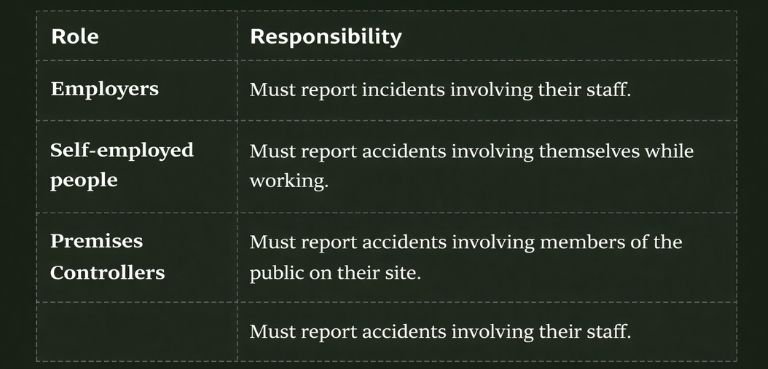
Do employees or witnesses ever have to file RIDDOR reports themselves? Generally, the answer is no. An injured worker does not report their own injury. The boss must do it.
What should you do if your employer refuses to report a RIDDOR incident? You can speak to a union representative. Alternatively, you can contact the HSE directly for advice. It is your right to be safe.
What Types of Incidents Must Be Reported Under RIDDOR?
Now we must look at what needs to be reported under RIDDOR. This can be tricky. Not every cut or bruise needs a report. Reporting everything would overwhelm the system. Therefore, only serious events count.
We will clarify that not every accident is RIDDOR-reportable. The law splits these into four main groups:
- Deaths and injuries.
- Occupational diseases.
- Dangerous occurrences.
- Gas incidents.
What Counts as a Reportable Injury Under RIDDOR?
First, let’s look at physical hurts. What is a “specified injury” under RIDDOR? These are serious injuries that are listed in the regulations.
What are examples of RIDDOR-reportable injuries?
- Fractures: Breaking a bone, except for fingers, thumbs, or toes.
- Amputations: Losing an arm, hand, or finger.
- Loss of sight: Any permanent damage to the eyes.
- Crush injuries: Damage to internal organs.
- Burns: Serious burns covering over 10% of the body.
Furthermore, there is a time rule. What is the “over 7 days incapacitation” rule, and how does it differ from “over 3 days”? If a worker cannot work for more than seven days, you must report it. This includes weekends. If they are off for only three days, you must record it in a book, but you do not need to report it to the HSE.
Which Work-Related Illnesses and Diseases Must Be Reported?
Sometimes work makes you sick slowly. What is a “reportable occupational disease” under RIDDOR? This is an illness caused directly by work.
Here are common RIDDOR report example categories for diseases:
- Carpal Tunnel Syndrome: From using vibrating tools or typing.
- Occupational Asthma: From breathing in dust or flour.
- Occupational Dermatitis: Skin problems from chemicals.
- Hand-Arm Vibration Syndrome: From using heavy power tools.
Who normally confirms a disease diagnosis for RIDDOR purposes? A doctor must tell you in writing. You cannot just guess. Once a doctor writes a note, the employer must report it.
What Are Dangerous Occurrences Under RIDDOR?
Sometimes, nobody gets hurt, but it was very close. What is a “dangerous occurrence”? This is essentially a “near-miss” event. Do you need an injury for something to be a RIDDOR dangerous occurrence? No, you do not. The event itself is enough.
Examples of dangerous occurrences include:
- Construction: A scaffold is collapsing.
- Manufacturing: An explosion or fire will stop work for 24 hours.
- Lifting equipment: A crane overturning or a load falling.
- Pressure systems: A pipe bursting or exploding.
- Electrical incidents: An electrical short circuit caused a fire.
When Are Gas Incidents Reportable Under RIDDOR?
Gas is hazardous. Which gas-related incidents fall under RIDDOR? This usually involves death or loss of consciousness due to gas. Therefore, who must report gas incidents? Usually, this is the job of registered gas engineers. If they see a dangerous gas appliance, they report it.
Realistic examples to make it clear:
- A boiler is leaking carbon monoxide in a rented home.
- A gas leak that causes people to faint.
- Poorly fitted gas pipes that could explode.
When Do You Need to Make a RIDDOR Report?
Timing is crucial. You must follow RIDDOR time limits / RIDDOR deadlines. If you wait too long, you break the law.
Here is a simple table to help:
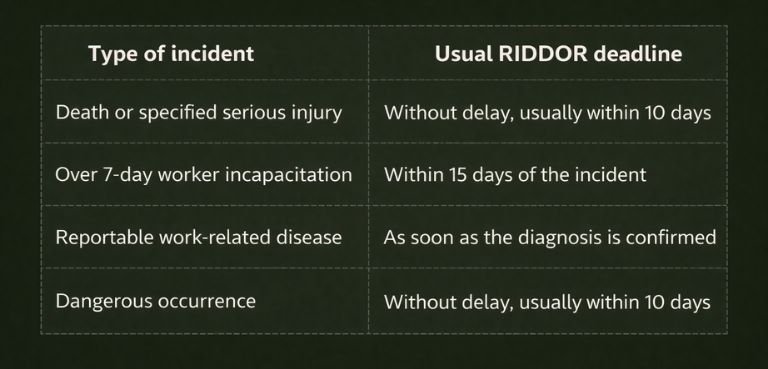
You should also update your internal records as soon as possible. Even if something is not RIDDOR‑reportable, you still record it inside the company. These records help you spot trends and defend against false claims.
How Do You Submit a RIDDOR Report Step by Step?
Submitting a report is easier than you think. Where do you go to submit a RIDDOR? You mostly use the HSE website. There is a phone line, but it is only for fatalities.
Here is a step-by-step outline of the online reporting process:
- Go to the HSE RIDDOR website.
- Choose the correct form (Injury, Disease, or Dangerous Occurrence).
- Fill in the details about the company and the injured person.
- Describe the accident clearly.
- Click submit.
Do you get confirmation or a reference number after submitting? Yes. You will receive a copy sent to your email. This is your proof.
Should you keep a copy of your RIDDOR submission, and for how long? Yes, absolutely. You must keep these records for at least three years. In some cases, keeping them for six years is better for insurance.
What Information Do You Need Before Filing a RIDDOR?
Do not start the form until you are ready. What basic details are required? You will need specific facts.
Gather these details first:
- Date, time, and place: Be precise about where it happened.
- Details of people involved: Name, job title, and address.
- Nature of injury: Is it a break, a burn, or a cut?
- Description of what happened: Keep it factual.
What evidence or records should you gather? It helps to have:
- Photos of the scene.
- Witness statements from other workers.
- CCTV footage, if available.
- Risk assessments for that specific job.
What Happens After You Submit a RIDDOR Report?
Many people worry about this part. Does the HSE automatically investigate every RIDDOR? No, they do not. They receive too many reports to visit everyone.
How might an HSE or local authority respond?
- No further action: They simply record the data.
- Request for information: They might email for clarification.
- Investigation: For serious accidents, an inspector might visit.
What are your obligations during an investigation? You must be honest at all times. Investigators also need full access to the site and relevant areas. In addition, your safety documents must be available for review. Trying to hide the truth only makes the situation much worse.
What Are the Penalties for Not Complying With RIDDOR?
Ignoring the rules is dangerous. Hence, penalties for not reporting RIDDOR can be severe. It is a criminal offence.
What are the risks of not reporting a RIDDOR incident? First, you are breaking the law. Second, you are hiding danger. So, can individuals be prosecuted? The answer is ‘Yes’. Directors and managers can be held personally responsible. It is not just the company that gets in trouble. Examples of typical penalties include heavy fines. We will discuss specific amounts later. However, knowing that courts take this seriously is important.
How can RIDDOR failures impact insurance, claims and reputation? If you do not report, your insurance might not pay out. Also, it looks awful for your business reputation. Good workers want safe employers.
How Does RIDDOR Fit Into Your Overall Health and Safety Duties?
RIDDOR is just one part of the puzzle. How does RIDDOR connect to other duties?
- Risk assessments: A RIDDOR report proves a risk assessment failed. You must update your assessment after an accident.
- Accident books: The Accident Book is the first step. RIDDOR is the second step for serious events.
- Training: Accidents often show that staff need more training.
How can RIDDOR reports help you improve workplace safety and prevent future incidents? They act as a lesson. If you report a slip on oil, you learn to clean oil faster. This prevents the next person from slipping.
What Are the Most Common RIDDOR Mistakes Employers Make?
Even good bosses make mistakes. Here are common errors to avoid.
- Confusing RIDDOR with internal records: Putting it in the accident book is not enough for serious injuries.
- Over-reporting: Reporting minor cuts that are not reportable. This wastes time.
- Under-reporting: Hoping nobody notices a broken arm. This is illegal.
- Misunderstanding the “over 7 days” rule: Forgetting to count weekends or rest days.
- Lack of Training: Not training managers on when to trigger a RIDDOR report.
How Can Small Businesses Make RIDDOR Compliance Easier?
Small shops and cafes have to follow the same rules as giant factories. How can small businesses put simple systems in place?
- Designate a Safety Person: Have one person learn the rules.
- Use a Calendar: Mark the 15-day deadline clearly.
- Keep a Bookmark: Save the HSE reporting page on the office computer.
How can you train staff quickly and effectively on RIDDOR? You do not need a long course. A 10-minute meeting explaining “what to do if someone gets hurt” is a good start.
Are there templates or tools that can help? Yes. The HSE website has free leaflets. You can print these out. They serve as quick reminders.
How Has RIDDOR Changed Recently?
Laws do change over time. It is important to stay updated on RIDDOR regulations from 2013 and newer shifts.
Since 2021, the focus has been on digital reporting. The HSE wants everything online. Also, Post-Brexit, the rules still apply. The UK kept these high standards to protect workers.
What about future trends? We might see AI reporting tools soon. These could help companies identify risks before accidents happen. However, the human duty to care will always remain.
What Are the Penalties for Not Complying with RIDDOR?
We mentioned penalties before, but let’s look at the details. The courts are very strict.
- Fines: In the Crown Court, fines are unlimited. The average fine is often over £10,000.
- Case studies: There was a case where a company was fined £500,000 for an unreported fatality. This shows how serious it is.
- Prison: For very serious breaches, managers can go to prison. The maximum is usually 2 years.
Tips: How to audit your compliance. Check your accident book every month. Ask yourself, “Did we report the serious ones?” If you missed one, report it late. Better late than never.
Final Thoughts on What Is a RIDDOR
We encourage you to take three steps today:
- Review your current incident reporting procedures.
- Train key staff on RIDDOR requirements.
- Check that you have an Accident Book ready.
If you are unsure, speak to a health and safety consultant. Protecting your team is the most valuable thing you can do. Stay safe, follow the rules, and keep your business healthy.

RIDDOR Training
Course Description :
- Certificate: Yes(Free)
- Accreditation: CPD Accredited
- Access: Lifetime