No products in the cart.
An SMP (Single Minded Proposition) is the one big idea your brand or campaign stands for. It’s the clear message that ties together every advert, social post, and creative brief — keeping your marketing focused and powerful. So, what is a single minded proposition in plain terms?
In a world full of noise, an SMP is what keeps your message sharp. It’s not about saying everything; it’s about saying the one thing that truly matters. Think of it as your campaign’s heartbeat — simple, strong, and memorable. It’s the promise or truth that makes people stop, think, and feel something about your brand. It’s why they should choose you — and not someone else.
In this blog, we’ll break down SMP marketing in the simplest way possible. You’ll learn what it means, why it matters, and how to craft one that really connects with your audience — plus, we’ll share a few real examples to inspire you.
What Does “Single Minded Proposition” Mean?
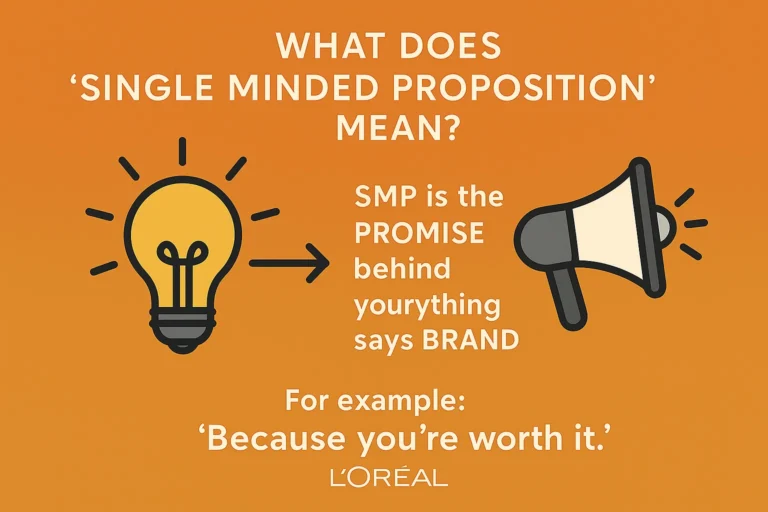
Let’s keep it simple. A Single-Minded Proposition, or SMP, is a short, clear statement that sums up the one most powerful reason people should care about your brand or message. It’s not a long description or a clever tagline — it’s the heart of your idea, the truth that everything else should connect to.
Think of it like this: your SMP is the promise behind everything your brand says or does. Whether you’re writing an advert, a social post, or a creative brief, it all should point back to that single idea.
You’ve actually seen great SMPs before — they’re hiding behind some of the world’s most famous taglines.
For example:
- “Melts in your mouth, not in your hand.” – M&M’s
- “Because you’re worth it.” – L’Oréal
These lines work because they express one clear thought that people instantly understand and feel connected to. They tell you not just what the product is, but why it matters.
So, when we talk about a single-minded proposition, we’re really talking about focus. It’s about stripping away the noise until only one powerful message remains — the one that moves your audience and gives your brand a reason to exist in their minds.
Why a Single-Minded Proposition Matters in Marketing

In marketing, clarity is power. A great idea can lose its impact if it’s hidden behind too many messages. That’s where a Single-Minded Proposition comes in — it brings everyone back to one clear thought that drives everything your brand says and does.
1. It Keeps Everyone Focused
When your team knows the one thing your brand stands for, everything becomes easier. The SMP gives focus — it aligns writers, designers, and strategists so they’re all building around the same core idea. No mixed signals, no confusion, just one united message.
2. It Prevents Mixed Messages
Without a clear SMP, your brand can sound like a different person on every channel — serious in one ad, playful on social media, and confusing on your website. A strong proposition prevents that. It acts like a compass, guiding your tone, visuals, and claims so your audience always hears the same consistent voice.
3. It Creates Consistency Across Every Channel
From your packaging to your website and social media posts, your message should always feel connected. That’s the power of a strong brand messaging framework — and it all starts with one clear SMP. When every piece of communication carries the same message, people begin to remember and trust it.
4. It Strengthens Your Brand Promise
Your brand promise is what your audience believes you’ll deliver — quality, comfort, confidence, joy, or something else entirely. The SMP is what keeps that promise alive. It reminds your team what matters most and helps you express it in a way that feels authentic and true.
5. It Builds Trust and Recognition
Audiences remember brands that sound consistent and confident. When your campaigns stay true to a single idea, people recognise your voice instantly — and that trust is what turns casual viewers into loyal fans.
How to Write a Strong Single-Minded Proposition
A great Single-Minded Proposition (SMP) isn’t just clever wording — it’s the foundation of your brand’s message. When written well, it helps your audience understand exactly why your product matters and gives your team one powerful idea to build around.
Here’s a simple, step-by-step process on how to write a single minded proposition that truly works.
1. Identify the Core Benefit
Start with the most important benefit your product or service delivers. Ask yourself:
- What’s the main value people get?
- Why does it matter to them?
Focus on one key takeaway — the single, emotional or practical reason people should care. This becomes the heart of your message.
2. Understand Your Audience Insight
A good SMP connects your brand benefit to a real human truth. Think about what your audience feels, struggles with, or dreams about. When your message speaks to that emotion, it becomes relatable — and memorable.
Example: If you sell fitness products, your insight might be: “People want to feel proud of what their body can do, not just how it looks.”
3. Keep It Short and Simple
Your SMP should be one clear sentence, not a paragraph. Avoid marketing jargon and long explanations. A single, easy-to-understand line will stick better in your team’s mind — and in your audience’s. Think of it as your brand’s “north star” — short, sharp, and powerful.
4. Be Specific, Not Generic
Don’t say things like “We offer great quality” or “We put customers first.” Everyone says that. Instead, be clear about what makes your brand different.
Example: Instead of “We deliver fast,” say, “Your groceries at your door in under 30 minutes.”
Specific messages are more believable, more memorable, and more persuasive.
5. Test the Fit
Once you’ve written your SMP, test how well it fits your brand. Ask yourself:
- Does it feel true to what we do?
- Does it match our tone of voice?
- Would our customers believe it?
- Does it work across ads, social media, packaging, and web copy?
If it feels right everywhere, your SMP framework is strong and ready to guide your marketing.
Simple Single-Minded Proposition Template
Use this easy single minded proposition template to get started:
For [target audience], [brand name] is the [category] that [core benefit or promise], because [key reason to believe].
Example:
For busy parents, FreshBox is the meal kit that saves time without sacrificing taste, because every recipe is ready in 15 minutes.
This simple structure keeps you focused on your audience, your promise, and the reason they should trust you.
Your SMP should feel natural — something you could say out loud with confidence. If it sounds clear, focused, and true to your brand, you’ve written a proposition worth standing behind.
Good vs Weak SMPs (Examples That Stick)
A strong Single-Minded Proposition (SMP) captures one powerful idea — simple, emotional, and memorable. A weak SMP tries to say too much, uses vague language, or focuses on features instead of feelings.
Here’s how to spot the difference.
|
What Makes a Strong SMP |
What Makes a Weak SMP |
|
Focuses on one clear, emotional benefit. |
Lists too many ideas or product features. |
|
Feels human, not corporate. |
Sounds generic — could fit any brand. |
|
Easy to remember and repeat. |
Lacks emotion or focus. |
|
Works across every channel — ads, packaging, web, and social. |
Doesn’t create a lasting impression. |
Strong SMP Examples
- M&M’s – “Melts in your mouth, not in your hand.” This line focuses on one simple product benefit. It’s visual, memorable, and believable — a perfect example of clarity and focus.
- L’Oréal – “Because you’re worth it.” An emotional statement that connects personally with the audience. It doesn’t describe the product; it empowers the customer.
- Nike – “Just do it.” Short, bold, and motivational. It captures the brand spirit in three words and applies to anyone who wants to achieve something.
- FedEx – “When it absolutely, positively has to be there overnight.” A clear, confident promise. It tells customers exactly what FedEx stands for — reliability and speed.
Weak SMP Examples
- “Great quality, fast service, unbeatable prices.” This line tries to say everything and ends up saying nothing. It’s generic, forgettable, and has no emotional pull.
- “Helping people live better lives through innovation and care.” Sounds nice, but it’s vague. You can’t tell what the brand does, who it helps, or why it’s different.
How an SMP Differs from a Tagline or USP
They sound similar, but each plays a unique role.
SMP (Single-Minded Proposition): Your core internal idea — the guiding thought behind every message. Example: Nike’s SMP – Everyone can achieve through movement.
Tagline: Your public line — short, catchy, and made for your audience. Example: “Just do it.”
USP (Unique Selling Proposition): Your tangible difference — the factual reason your product stands out. Example: FedEx – Guaranteed overnight delivery.
That’s the simple difference between SMP vs USP — one shapes the message, one says it, one proves it.
How to Use an SMP in a Campaign
Your Single-Minded Proposition isn’t just a nice line — it’s your campaign’s North Star. Here’s how to make it work for you:
- Start every brief with it: Put your SMP right at the top of your creative brief. It reminds everyone what the campaign truly stands for.
- Use it as a filter: Got a new idea? Check if it fits your SMP. If it doesn’t connect, it doesn’t stay.
- Let it guide your look and tone: Your words, visuals, and voice should all reflect the same core feeling. Keep it consistent and real.
- Know what not to say: A clear SMP keeps you from overloading your message. Stick to one strong thought.
- Keep everyone aligned: Share the SMP with your whole team — from copywriters to designers — so every piece feels like part of one big story.
When you use SMP in campaign planning this way, it turns your creative brief SMP into a tool for sharper, simpler, and stronger brand strategy messaging — every single time.
Common Mistakes When Creating an SMP
Even experienced marketers can get stuck when writing a Single-Minded Proposition. Here are the most common pitfalls — and how to fix them fast.
1. Trying to Say Too Much
Packing your SMP with lots of benefits or ideas only confuses people. Focus on one clear promise — the single thing you want your audience to remember.
Quick fix: Choose the most important benefit and build your message around it.
2. Writing for You, Not Them
It’s easy to write from your brand’s perspective, but your audience cares about what’s in it for them.
Quick fix: Write from your customer’s point of view. Ask, “How does this help or inspire them?”
3. Using Clichés and Buzzwords
Phrases like “quality service” or “innovative solutions” sound safe — but they also sound like everyone else.
Quick fix: Use clear, real language that paints a picture. If any brand could say it, rewrite it.
4. Forgetting the Emotion
An SMP that focuses only on facts feels flat. People make decisions based on feeling first, logic second.
Quick fix: Decide how you want your audience to feel, then write to spark that emotion.
5. Ignoring the Brand’s Truth
Overpromising or writing something that doesn’t match your brand reality weakens trust.
Quick fix: Be honest and authentic. A good SMP reflects what your brand genuinely stands for.
Avoiding these single minded proposition mistakes keeps your message sharp and believable. The fewer SMP pitfalls you fall into, the stronger and more human your brand messaging will be.
How to Test if Your SMP Works
Once you’ve written your Single-Minded Proposition, it’s time to see if it really does its job. A strong SMP should feel natural, believable, and easy to remember — not forced or confusing. Start with a quick sense check: can someone understand it in five seconds or less? If they need to read it twice, it’s probably too complicated.
Next, see if it sticks in memory. After a short while, ask someone to repeat what they remember. If they can’t recall the main point, the message might not be clear enough. Then check for truth and product fit — does the line genuinely reflect what your brand delivers, or is it just wishful thinking? Authenticity matters more than clever wording.
Finally, ask yourself one simple question: would your customers actually repeat it? If it sounds like something real people would say, you’ve nailed it. When you test single minded proposition ideas this way, you quickly validate your SMP and make sure it’s strong enough to guide your campaign. Use this as your simple SMP checklist to keep every message focused, honest, and memorable.
Final Thoughts: Keep It Single, Strong, and Clear
A great Single-Minded Proposition doesn’t try to say everything — it says the right thing. One focused idea can guide your whole brand, shape your tone, and make your message instantly recognisable. When your SMP is clear, honest, and true to your audience, everything else — your ads, taglines, and campaigns — fall into place.
Keep your message single, strong, and clear — and watch how far your brand can go.
Frequently Asked Questions (FAQs)
1. What is the difference between SMP and USP?
SMP is your emotional brand idea; USP is your factual difference. SMP connects hearts, USP proves value — together they make your brand clear and convincing.
2. What is the difference between tagline and single-minded proposition?
A tagline is the public message people see; a single-minded proposition is the internal idea that shapes it. The SMP inspires, the tagline expresses.
3. What is Apple’s single-minded proposition?
Apple’s SMP focuses on empowering creativity through simplicity — technology that feels human, elegant, and effortless, inspiring people to think differently and create freely.
4. What does being single-minded mean?
Being single-minded means staying focused on one clear goal or belief without distraction, keeping your purpose and direction strong and consistent.
5. Is being single-minded a good thing?
Yes. In marketing, it builds clarity and confidence, helping brands communicate one strong idea people remember and believe in.
6. What is a deductive person?
A deductive person reasons from general facts to specific conclusions, valuing logic, structure, and clear evidence in decision-making.
7. What is a pedantic person?
A pedantic person focuses too much on details or rules, sometimes missing the bigger picture or overall meaning.
8. Am I an inductive or deductive thinker?
Inductive thinkers notice patterns and form conclusions; deductive thinkers apply rules to facts. Most people naturally use both.
9. What is a spatial personality?
A spatial personality processes information visually, seeing shapes, spaces, and patterns easily — common in designers, artists, and architects.