No products in the cart.
Working with vehicles and machines can be very dangerous. Many people ask What is banksman and how they help. That’s why having someone to guide and coordinate them is so important, and here the banksman comes out. A banksman controls vehicles and machines on construction and industrial sites. They guide drivers using hand signals, radios, or flags. Banksmen watch for hazards, warn workers, and stop accidents before they happen. Their role is critical because reversing vehicles causes many injuries and deaths at work. With proper training, banksmen keep sites safe, and work runs smoothly.
Every year, many accidents involve vehicles. Reversing vehicles causes about a quarter of deadly workplace accidents. Moving vehicles hit around 16% of workers who die at work in Great Britain. On average, 21 workers die each year from vehicle accidents. Employers must plan safe routes and safe systems. A trained banksman is one key safety control. They guide drivers and watch people near vehicles. Good banksmanship skills prevent accidents and save lives.
In this article, we explain what a banksman does and their main duties. We also show how you can train and become a safe, skilled banksman.
How to Become a Banksman
You do not need formal academic qualifications to become a banksman. However, you must complete approved training in vehicle marshalling, safety, and hand signals. Popular courses include CPCS, RoSPA and High Speed Training. You need good fitness, clear communication skills, and, in some cases, to be at least 18 years old. Training can take a few hours, a full day, or happen on the job.
Steps to Become a Banksman:
- Learn the Role: A banksman (or traffic marshal) directs vehicle movements safely. For example, they prevent accidents on construction sites, factories, and warehouses.
- Get Trained: Employers usually want proof of competence. Training covers safe driving techniques, standard hand signals, hazard spotting and risk assessments.
- Get Accredited: Next, choose courses approved by CITB or Smart Awards. You often get a certificate and photo ID.
- Gain Experience: Beginners can start as site workers or in a construction apprenticeship. Then, they can practise marshalling skills.
Skills Needed:
- Good awareness of space and distance
- Clear communication
- Focus and concentration
- Physical fitness
Training Options:
- Additionally, online courses let you learn at your own pace with videos and quizzes.
- Practical classes help you practise on-site skills in real-life conditions.
- Finally, courses usually last from a few hours to a full day.
Where Banksmen Are Used
Banksmen, also called traffic marshals, work in places where vehicles and machines can be dangerous. For instance, they guide drivers when space is tight, visibility is low or people are nearby.
Key Places:
- Construction Sites: Directing trucks, cranes and excavators, especially when reversing.
- Warehouses and Logistics: Guiding lorries in busy loading areas.
- Ports and Shipping Yards: Moving containers and heavy vehicles safely.
- Factories and Industrial Sites: Managing forklifts in crowded areas.
- Public Works and Utilities: Helping trucks and excavators near roads or public spaces.
- Military Bases: Guiding large or armoured vehicles in tight spaces.
When Banksmen Are Needed:
- Low visibility or blind spots
- Reversing vehicles
- Tight or confined spaces
- Crowded areas with many people
- Lifting operations with cranes
In addition, banksmen must be trained. Moreover, they are used when other safety measures are not enough. After that, they help prevent accidents. As a result, their work keeps everyone safe.
What Are a Banksman’s Duties and Responsibilities?
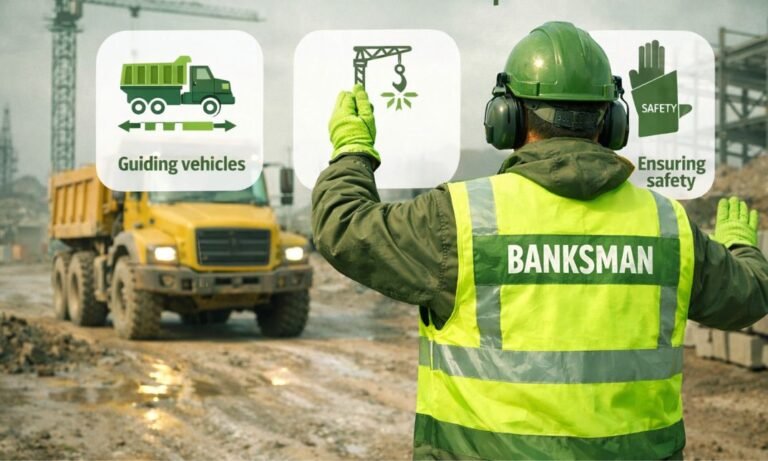
A banksman, also called a traffic marshal, is a trained worker who keeps people and vehicles safe. They work on construction sites, in warehouses, or in industrial areas. Their main job is to guide vehicles and machines to prevent accidents, injuries and damage.
Key Duties:
- Guide vehicles using hand signals or radios, especially when drivers cannot see well.
- Watch for dangers and keep people away from unsafe areas.
- Check for overhead cables or underground pipes.
- Help with reversing, acting as the driver’s eyes and ears to prevent crashes.
- Organise vehicle movements to reduce congestion and avoid accidents.
- Make sure vehicles and machines stay in safe zones.
When a Banksman is Needed:
A banksman is needed when drivers cannot see clearly. For example, they are important during reversing, loading, or unloading in busy or tight areas. Furthermore, banksmen are used when other safety measures are not enough to keep people and vehicles safe.
Skills Needed
Banksmen need clear communication skills, either by talking or using a radio. In addition, they must know standard hand signals to guide drivers safely. Also, they should stay aware of everything around them to protect workers and prevent accidents.
Is there a banksman qualification?
Yes, you can gain training and cards for the banksman role. The law does not give one official “banksman licence” for everyone. However, most employers want clear proof that you can work safely with vehicles. So, they often ask for a banksman or traffic marshal training certificate. Common courses include NPORS, CPCS, and other approved industry schemes. These courses teach risk checks, HSE hand signals and safe moving and reversing.
Key banksman qualification details
- Training types: You can learn online or join practical, on-site training sessions.
- Most courses last from half a day to a full day.
- Common accreditations: Many sites accept NPORS or CPCS cards for banksman work.
- Validity: Many training providers keep their certificates valid for three years.
- Requirements: Many sites ask for a CSCS card before you start work.
- Scope: Training covers guiding vehicles in tight spaces and during reversing.
- It also covers simple site safety rules and traffic marshal duties.
These courses help you follow Health and Safety rules in construction and transport work.
Banksman Skills, Knowledge, and Experience
A banksman works as a trained guide for vehicles and machines. People also call this role a traffic marshal. Banksmen work on building sites, in warehouses, and in many industrial areas. Their main job is to keep people safe and prevent accidents. To do this, they need clear communication, strong safety knowledge and calm behaviour under pressure.
Key Skills
First, a good banksman needs these key skills:
- Clear communication: Speak in a calm, loud voice. Use radios well. Know standard hand signals.
- Safety awareness: Spot risks early and keep people, vehicles, and buildings safe.
- Spatial awareness: Judges distances well and guides vehicles in tight spaces.
- Teamwork: Work closely with drivers and stay calm in busy, stressful moments.
- Physical fitness: Have good strength, stamina and coordination for long shifts.
- Decision-making: Know when a vehicle can move and when it must stop.
Required Knowledge
Next, a banksman needs the right knowledge:
- Site safety rules: Understand health and safety rules, including HSE guidance.
- Vehicle awareness: Know blind spots, turning circles, and limits of trucks and machines.
- Traffic management: Understand site routes, speed limits and safe walking areas.
Experience and Training
Then, training and experience help you grow in the role:
- Training: You do not need formal school qualifications. However, proper banksmanship training is required. Many courses finish with a short test.
- Experience: Working in construction, warehousing or transport helps you learn faster.
- Refresher training: Take training every few years to stay up to date with safety rules.
Where Banksmen Work
Finally, banksmen can be found in many workplaces:
- Construction sites
- Docks and ports
- Warehouses and factories
- Highways and roadworks
Common Mistakes Banksmen Should Avoid
Even experienced banksmen can make mistakes, and some can be very dangerous. To start with, never stand in a blind spot. Drivers cannot see you there and even a small movement can cause serious injury. Always position yourself where the driver can clearly see you.
Next, avoid using unclear signals. Confusing gestures or rushed hand signs can make drivers stop suddenly, reverse incorrectly or hit objects. Always make your signals slow, clear, and easy to understand. Make sure the driver is watching and ready to follow your instructions. Moreover, poor communication with drivers can cause accidents. Shouting, mumbling, or giving instructions too late increases the risk. Speak calmly and clearly, use radios if needed and confirm that the driver understands before moving.
Finally, do not let pedestrians enter the working area. One careless step can cause a serious accident. Always guide people to safe zones and remind them to stay alert near vehicles. Remember that safety requires awareness, not only just rule-following. It is about protecting yourself, your team, and everyone around you. One wrong move can create big trouble, so maintain awareness at all times.
What’s the Difference Between a Traffic Marshal and a Banksman?
A banksman and a traffic marshal do similar jobs, but there are some key differences. Firstly, a banksman usually works on construction sites. They guide trucks, cranes, diggers, and other big machines. Their main job is to keep workers, visitors and people nearby safe while vehicles move. Banksmen also check for hazards like uneven ground, overhead cables or blind spots. They use clear banksman hand signals to direct drivers safely, ensuring everyone knows what to do.
After that, a traffic marshal usually works in warehouses, docks, or busy loading areas. They help lorries and smaller vehicles move safely in tight spaces. They make sure traffic flows smoothly, prevent jams and stop accidents. Traffic marshals often manage pedestrian areas inside busy buildings or yards, keeping workers and visitors out of danger. Both banksmen and traffic marshals drive vehicles or operate machinery. They also do not deliver goods, repair vehicles or load machines. Their main responsibility is safety and clear guidance.
Ultimately, the main difference is where they work. Banksmen are common on construction sites with heavy machines and building work, using tools like banksman hand signals to guide vehicles. Traffic marshals are common in warehouses, ports, or busy loading areas where people and vehicles move a lot. Both roles are very important. Without them, accidents can happen quickly, so they help protect everyone and keep work running safely.
Final Thought: What is Banksman?
A banksman is very important for keeping people safe around vehicles and machines. First, they guide drivers, watch for dangers, and stop accidents. With the right training and skills, a banksman can save lives and make work safer. Whether on construction sites, warehouses, or ports, their job helps work run smoothly. Also, learning to be a banksman is easy with training, practice and focus on safety. Always stay alert, speak clearly and follow safety rules.
FAQs: What is Banksman?
1. What is the job of a banksman?
- A banksman guides vehicles and machines safely, watches for hazards and prevents accidents on sites.
2. What is another name for a banksman?
- A banksman is also called a traffic marshal.
3. What does banksman mean?
- A banksman is a trained worker who directs vehicles and keeps people safe.
4. Why is banksman training important?
- Training teaches safe vehicle guidance, hazard spotting and accident prevention.
5. Do you need a qualification to be a banksman?
- Yes, employers usually want a banksman training certificate from an approved course.
6. What is a banksman job salary?
- Banksmen in the UK earn around £18,000 to £30,000 per year, depending on experience and location.
Level 3 Banksman Course
Course Description :
- Certificate: Yes(Free)
- Accreditation: CPD Accredited
- Access: Lifetime