No products in the cart.
Every busy kitchen has risks, but HACCP gives those risks a clear route to control. The 7 principles of HACCP help food businesses manage food safety before problems reach the customer. The system began in the 1960s, when NASA, the Pillsbury Company and U.S. Army laboratories worked together to make astronaut food safer.
Today, the same approach guides cafés, takeaways, restaurants and food factories across the UK. This matters when service gets busy. One missed hand wash, one warm fridge, or one undercooked dish can create real danger. HACCP turns those moments into clear daily checks. It helps your team find hazards, control key steps, take action and keep proof.
What is the meaning of HACCP in food safety?
The full form of HACCP is Hazard Analysis and Critical Control Point. It helps food businesses find food safety risks, control the most important steps, check results, fix problems and keep proof. In simple words, HACCP helps stop unsafe food before it reaches the customer. It is a preventive system rather than a reaction to a problem.
The meaning of HACCP in food safety is best understood as a journey. It is a way of looking at your food from the moment it arrives at the back door until it is served on a plate. It covers every single step, including delivery, storage, preparation, cooking, cooling and cleaning. By focusing on the points where things are most likely to go wrong, you can ensure that your food remains safe.
To understand the system, we must break down the two main parts:
- Hazard Analysis: This involves looking at your food and your kitchen to find anything that could cause harm to a customer.
- Critical Control Point (CCP): This is a specific step where you must take action to make the food safe. A classic example is cooking meat to a temperature that kills bacteria.
HACCP is not a “one size fits all” form. A small café selling pre-packaged sandwiches will have a different HACCP plan than a large catering company making thousands of hot meals. However, both must follow the same HACCP 7 principles to ensure they are providing safe food. Instead of just checking if the food looks okay at the end, HACCP prevents problems at every stage of the process.
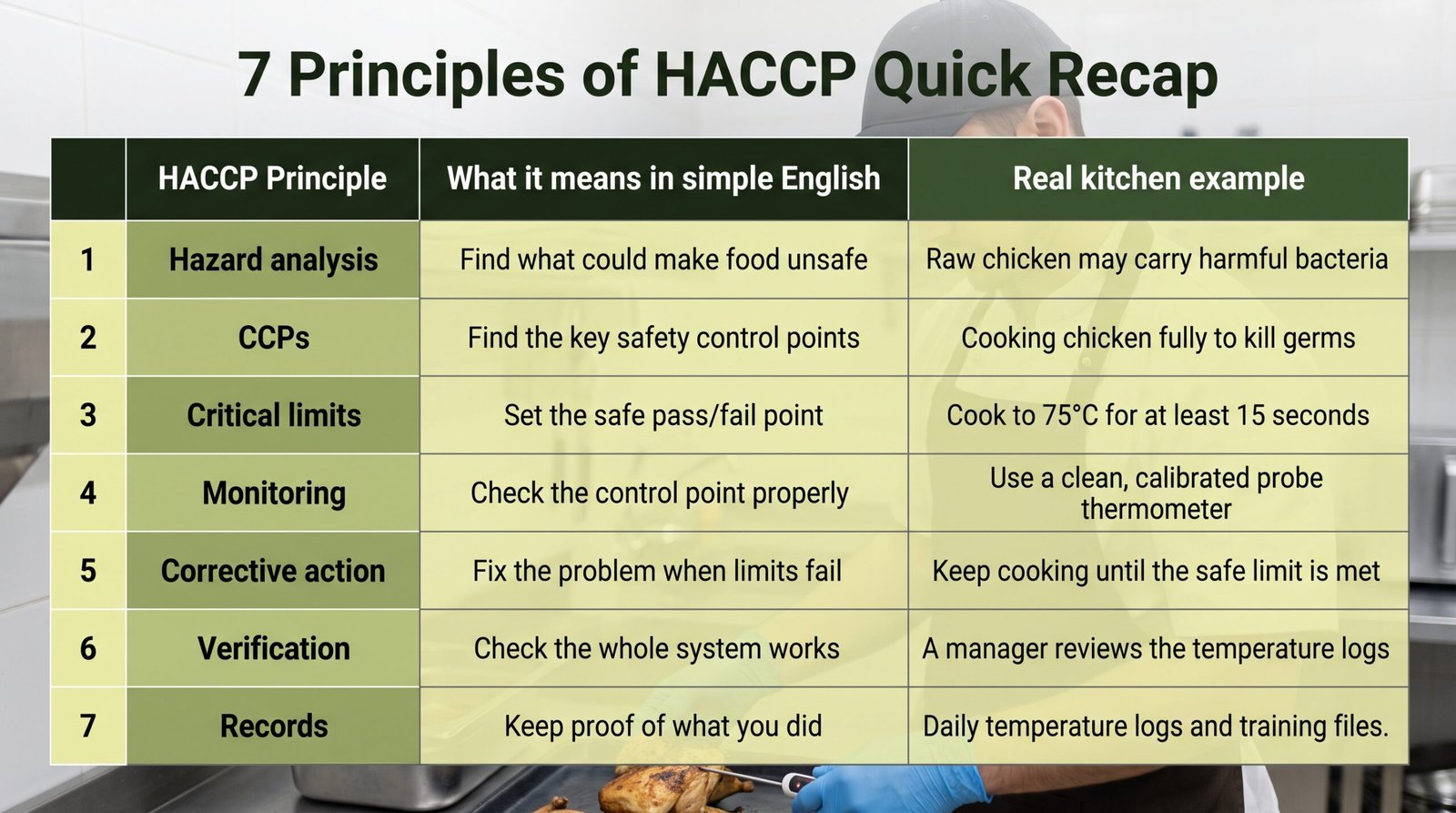
What Are the Seven Principles of HACCP? Quick Recap
The seven principles of HACCP are the full safety path. They help a business find risks, control the most important points, set safe limits, check results, fix problems, review the system and keep proof. Together, they form a complete food safety management system.
Why Do the 7 Principles of HACCP Matter in the UK?
The 7 principles of HACCP matter because UK food businesses must manage food safety in a clear way. These principles help staff find hazards, control key points, set safe limits, check results, fix problems, review the system and keep records. This ensures compliance with UK food hygiene law.
The part people need to hear is that HACCP is not just for inspectors. It is the backbone of your business reputation. Whether you run a takeaway, a care home kitchen, or a large catering firm, you have a legal duty to put a HACCP-based food safety system in place. This requirement comes from Regulation (EC) No 852/2004 on food hygiene, which still applies in UK law.
If a food safety officer visits your premises, they will look for your written procedures. They want to see that you understand the specific risks in your kitchen. Using the 7 principles of HACCP helps you achieve a high food hygiene rating, which builds trust with your local community.
Why HACCP matters for your business?
- Stops unsafe food before it is ever served.
- Gives staff clear, easy-to-follow food safety steps.
- Reduces guesswork during busy shifts.
- Supports smoother inspections and stronger due diligence.
- Protects customer trust and your business’s future.
For many small businesses, the Food Standards Agency HACCP guidance suggests using Safer Food Better Business (SFBB). This is a simplified version of HACCP designed for small caterers and retailers. It allows you to follow the law without needing a degree in food science.
What Should Be Ready Before HACCP Starts?
Before HACCP starts, the basic food safety rules must already work. These are called prerequisites. They include cleaning, staff hygiene, pest control, supplier checks, safe equipment, waste control, safe storage and staff training. These foundations must be strong before the 7 principles can be applied effectively.
The part most people forget is that HACCP cannot fix weak daily hygiene. If your kitchen is dirty or your staff do not wash their hands, even the most expensive HACCP plan will fail. You must have a prerequisite plan in place first. Think of this as the foundation of a house. Without it, the walls will crumble. This plan includes:
- Cleaning and Sanitation: A clear schedule of what, when and how to clean.
- Pest Control: Checking for signs of pests and having a professional contract if needed.
- Supplier Control: Only buy from trusted sources that handle food safely.
- Hygiene Training: Ensuring all staff understand the basics of food safety. You can find more about this in a Level 2 Food Hygiene course.
An essential step before starting the 7 principles is creating a process flow diagram. This is a simple map that shows the journey of your food. For example, a flow might look like this:
Delivery, Cold Storage, Preparation, Cooking, Hot Holding and finally Service.
Once you have your basics and your flow diagram ready, you can start with Principle 1.
How Do You Spot Food Safety Hazards Early?
Principle 1: Conduct a Hazard Analysis
Principle 1 means finding anything that could make food unsafe. A business checks every step in the food journey, lists possible hazards and decides which ones could seriously harm customers. This hazard analysis involves identifying biological, chemical, physical and allergenic risks throughout the entire production process.
The detail that makes the difference is that not every hazard becomes a CCP. In this stage, you are acting like a safety detective. You look at your flow diagram and ask: “What could go wrong here?” You must look for four types of food safety hazards:
- Microbiological hazards: Bacteria like Salmonella or E. coli, viruses and moulds.
- Chemical hazards: Cleaning chemicals, unapproved additives, or natural toxins.
- Physical hazards: Glass, hair, metal chips from cans, or stones.
- Allergenic hazards: The 14 main allergens, such as nuts, gluten, or milk, can get into the wrong dish. You can learn more about this through Food Allergy Awareness training.
Hazard words to use clearly:
- Presence: The hazard is already in the food, such as bacteria in raw meat.
- Introduction: The process brings the hazard in, such as a fly landing on food.
- Growth: Bacteria can increase if food is left in the Temperature Danger Zone.
- Survival: The cooking step does not remove the hazard because it was not hot enough.
To decide which hazards are “significant,” you look at severity (how much harm it causes) and likelihood (how often it might happen). We often use a score of 1 to 3 for each. The highest significance score can reach 9. Only the most significant hazards move forward to become part of your control plan.
What Control Measures Reduce the Hazard?
A control measure is an action you take to stop a hazard. For example, keeping raw and cooked food separate is a control measure for cross-contamination. Buying from an approved supplier is a control measure for chemical risks. It is important to note that a control measure reduces the hazard, while monitoring checks whether that control measure works.
Which Steps Are Critical for Food Safety?
Principle 2: Determine Critical Control Points
Principle 2 means finding the steps where control is essential. These steps are called critical control points (CCPs). If control fails at a CCP, food may become unsafe. Cooking raw chicken is a simple example because heat can kill harmful bacteria and there is no later step to fix it.
The point worth remembering is that a CCP is where control matters most. Not every step in your kitchen is a CCP. For instance, receiving a delivery is very important, but if you have a cooking step later, that cooking step might be the actual CCP that kills the bacteria. A CCP is the “last chance” to make the food safe before it reaches the consumer.
Simple CCP decision questions:
- Does this step remove the hazard or lower it enough to make the food safe?
- Can the hazard reach unsafe levels if we do nothing at this step?
- Will a later step in the process remove the hazard for us?
- Would losing control at this point put the customer at immediate risk?
To help decide, many businesses use a HACCP decision tree. This is a series of questions that lead you to a “Yes” or “No” for each potential CCP. There are different versions, such as the Codex or Campden BRI decision trees. The business should record which tree it used. In some larger businesses, an operational prerequisite programme (OPRP) may control a serious hazard without making that step a full CCP.
Where Is the Safe Pass or Fail Point?
Principle 3: Establish Critical Limits
Principle 3 means setting a clear and safe limit for each CCP. A critical limit separates safe food from unsafe food. It should be observable, measurable and possible to check while food work is happening. It ensures that the control measure is working correctly to manage the hazard.
The part worth slowing down for is that a critical limit must be measurable. You cannot simply say “cook until it looks right.” That is not a limit because it is subjective. A limit must be a number or a very clear, objective observation.
Common examples of critical limits:
- Cooking: 75°C for 15 seconds (the accepted UK standard) or 70°C for 2 minutes.
- Chilled Storage: Food must be kept at 8°C or below, though 5°C is the recommended target.
- Milk Pasteurisation: Heating to 72°C for at least 15 seconds.
- Acidity: A pH level of 4.0 or below for certain preserved items.
- Physical: The total absence of metal or glass fragments.
Some businesses also use a target value. A target value is a safety buffer. If your critical limit is 70°C, you might set your internal target value at 72°C. This way, if the temperature drops slightly, you are still well above the dangerous “fail” point. These limits must be based on evidence, such as law, official guidance, or scientific studies.
How Do You Check That a CCP Stays Safe?
Principle 4: Establish Monitoring Procedures
Principle 4 means checking CCPs in a planned way. Monitoring procedures show whether the critical limit has been met. It also helps staff spot problems early, before unsafe food reaches the customer. Monitoring must be recorded to prove that the food was safe at that specific moment.
The useful truth is that monitoring only works when staff know exactly what to do. You need a monitoring plan that answers these questions:
- What will be checked? (For example, the core temperature of the cooked meat).
- How will it be checked? (For example, using a clean, calibrated probe thermometer).
- How often will it be checked? (For example, every single batch or every two hours).
- Who will check it? (For example, the head chef or a trained kitchen assistant).
- Who is the deputy? (Who checks if the main person is on a break?)
Monitoring can be continuous, such as a digital fridge alarm system, or non-continuous, such as a manual probe check. In-line checks happen during the process, while off-line checks happen at the end. Whatever method you choose, the staff must know how to record the results correctly.
Strong monitoring records should show:
- Exact date and time of the check.
- Actual result, such as 76°C rather than just a tick.
- Signature or name of the staff member.
- Equipment used, such as “Probe 1.”
- Any action taken if the check fails.
What If a Food Safety Check Fails?
Principle 5: Establish Corrective Actions
Principle 5 means planning what staff must do when a CCP fails. Corrective actions should fix the process, control affected food and stop the same problem from happening again. It should never depend on guessing. Every failure must be recorded along with the action taken to fix it.
The practical truth is that a failed check needs action, not hope. If you check a fridge and find it is 12°C, you cannot just close the door and hope for the best. You must have a pre-planned “What if” response that staff can follow immediately.
Three levels of corrective action:
- Restore control straight away: Fix the immediate problem. This might mean turning the oven up or moving food to a working freezer.
- Identify and control affected food: The team must decide what to do with food made since the last safe check. Does it need to be thrown away, or can it be safely re-cooked?
- Investigate the cause: Ask why it happened. Was it an equipment failure or a lack of staff training? You must stop the recurring problem.
Example: If a chicken breast reaches only 65°C, the corrective action is to keep cooking until it reaches the safe limit of 75°C. You then record what happened, who took the action and the final safe result. This ensures that no unsafe food ever reaches the customer.
How Do You Know the HACCP Plan Still Works?
Principle 6: Establish Verification Procedures
Principle 6 means checking that the HACCP system works in real life. It covers validation, verification and review. This step proves the plan has evidence behind it, works during daily food handling and stays up to date. It involves looking at the “big picture” of your food safety.
The thing most guides do not say is that HACCP fails when nobody checks it. This principle makes sure the plan on paper matches the work in the kitchen. It is split into three vital parts:
- Validation: Does the plan actually work? This happens before you start. It is the proof that your chosen temperatures and times will kill the bacteria you are worried about.
- Verification: Is the plan being followed correctly? This is a regular check. It might involve a manager looking at the temperature logs at the end of the week to ensure they are complete and accurate.
- Review: Is the plan still right for the business? This must happen at least once a year. You also need a review trigger, such as a new menu, a new supplier, or a change in UK food hygiene law.
Verification procedures might include thermometer calibration, staff observations, or even microbiological testing of food samples. Even if nothing has changed in your kitchen, you should still record that a review took place.
What Records Prove Your Food Safety Checks?
Principle 7: Establish Documentation and Record Keeping
Principle 7 means keeping proof. HACCP documentation and record keeping show what staff checked, what result they found, what action they took and who checked it. Good records help a business show “due diligence”, which is proof that you have done everything reasonable to protect the customer.
The truth most guides skip is that missing records can make safe work hard to prove. In the eyes of a food safety inspector, if it is not written down, it did not happen. Records are the “memory” of your safety system.
Your documentation should include:
- The full HACCP plan and list of hazards.
- The hazard analysis and CCP decision records.
- Evidence of your safe critical limits.
- Standard operating procedures for cleaning and cooking.
Your daily records should include:
- Food safety records like daily temperature logs.
- Corrective action records showing what you did when things went wrong.
- Staff training records to prove your team knows the rules.
- Pest control reports and supplier delivery notes.
You must decide where the records will live and how long you will keep them. Whether they are paper-based or digital, they must be accurate, current and easy to find when an inspector arrives.
How Can Small UK Food Businesses Apply HACCP?
Small UK food businesses can apply HACCP by keeping the system practical. The plan should follow the real food journey, from delivery to service. Staff should understand the checks, not just sign records. For a small takeaway or café, the Safer Food Better Business pack can make HACCP much easier to handle.
The topic becomes useful when HACCP fits the real kitchen, not just the folder in the office. If you own a small café, a takeaway, or a catering van, you do not need a complex 100-page manual. You need a system that your staff can actually follow during a busy lunch rush.
Simple way to apply HACCP principles
- Map your food journey from delivery to service.
- Mark exactly where food can become unsafe, such as during cooling.
- Decide where control matters most.
- Set clear and easy-to-understand limits.
- Train your staff using a HACCP Awareness course.
- Record what happens each day in a simple diary or logbook.
The Food Standards Agency has a specific Safer Food Better Business pack for different sectors, such as Indian, Chinese, or childminding businesses. This makes it much easier to comply with the law.
What Common HACCP Mistakes Should You Avoid?
Common HACCP mistakes happen when the plan does not match real work. A business may copy a plan from another shop, miss allergen risks, skip staff training, or forget to review the plan when the menu changes. These mistakes make the safety system weak and leave the business at risk.
The issue starts when the HACCP folder looks right, but the kitchen works differently. Here are the most frequent errors we see in the industry:
- Copying a plan: Your hazards are unique to your kitchen layout and your specific staff.
- Too many CCPs: If you make every single step a “critical control point,” your staff will become overwhelmed and stop checking them properly.
- Forgetting allergens: Allergenic hazards must be part of your hazard analysis. You cannot ignore them.
- Confusing control with monitoring: Remember that cooking is the control; the thermometer check is the monitoring.
- Fake records: Inspectors can easily tell if a month of records was written with the same pen on the same day. Honesty is essential for safety.
- Not training the team: If your staff do not understand why they are taking temperatures, they are more likely to make mistakes.
Final Thoughts: Why the 7 Principles of HACCP Still Matter
The 7 principles of HACCP still matter because they give food businesses a clear way to protect customers. They help teams find risks, control key steps, check results, fix problems, review the plan and keep proof. Over time, these steps turn food safety into a daily habit, not a last-minute worry.
HACCP is not only about avoiding problems with the council. It is about running a kitchen with care, pride and responsibility. Not only that, it also protects customers from illness and helps business owners build trust.
The real value of HACCP comes when the system becomes part of everyday service. When staff understand what to check and why it matters, food safety feels simple and practical. That is why the 7 principles of HACCP remain so important for cafés, takeaways, restaurants and food businesses across the UK. To build stronger knowledge and lead food safety with confidence, a Level 3 Food Hygiene course can be a useful next step.
FAQs About HACCP 7 Principles
1. What is CCP in food safety?
- A CCP means Critical Control Point. It is a step where you must control a food safety risk. Cooking chicken to a safe temperature is a common CCP.
2. What are the 5 C’s of food safety?
- The 5 C’s are cleaning, cooking, chilling, cross-contamination control and checking. These simple steps help food teams keep food safe from delivery to service.
3. What is a HACCP checklist?
- A HACCP checklist is a simple tool for checking food safety steps. It helps staff review hazards, CCPs, limits, monitoring, corrective actions and records.
4. What are the golden rules of HACCP?
- The golden rules of HACCP are simple. Find the hazards, control the key steps, set safe limits, check them, fix problems and keep clear records.
5. What are the 4 hazards of HACCP?
- The 4 HACCP hazards are microbiological, chemical, physical and allergenic hazards. These can include bacteria, cleaning chemicals, glass pieces and undeclared allergens.
6. How many HACCP audits per year?
- There is no single number for every business. Most food businesses should audit or review HACCP at least once a year and after any major change.

Level 3 HACCP Training Course
Course Description :
- Certificate: Yes(Free)
- Accreditation: CPD Accredited
- Access: Lifetime