No products in the cart.
What is working at height? It simply means working in any place where you could fall and hurt yourself if you do not have the right safety gear. At first, the legal rules might seem a bit complex. Still, they become easy to understand when you look at the facts and follow the correct steps.
Many people believe this only applies to tall ladders or rooftops. But the law also applies to things like vehicle pits, loading bays and even floor openings. So you have to be careful when you work up or down from ground level.
Now let’s get into it and know the details about what is working at height.
Simply, What Is Working at Height?
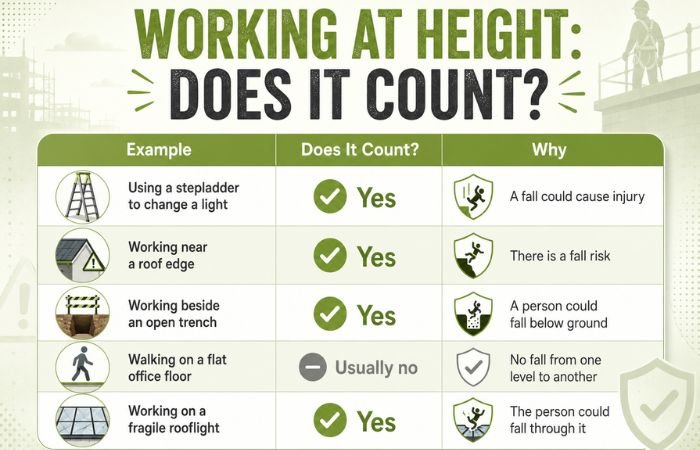
Working at height means any work where a person could fall from one level to another and suffer injury. This could mean falling from a ladder, roof, scaffold, platform, vehicle, or fragile surface. It also includes falling into an opening below ground.
The law does not focus on one fixed height. Instead, it focuses on whether a fall could cause personal injury. Therefore, even a low-level task can count if the risk is real.
Working at height is common in construction, cleaning, farming, warehousing, maintenance, telecoms, retail, and facilities work.
What Is the Definition of Working at Height?
The Health and Safety Executive provides clear rules for working at height within the UK. These regulations help to prevent serious injuries or deaths from falls during work tasks.
According to these rules, working at height occurs in any place where a person could fall and hurt themselves if they do not take precautions. Because of this, you must always think about the risks before you start a job above or below ground level.
Most people believe that only a fall from a great height is dangerous. In reality, there is no legal minimum height for these safety rules to apply. For instance, a worker on a stepladder or a person near an open floor hole is working at height. Ultimately, the chance of a physical injury matters much more than the distance of the fall.
Why Is Working at Height Dangerous?
The main risks of working at height involve a fall from one level to another, but the full picture is wider. These risks include:
- Falls from edges: These happen near roofs, scaffolds, platforms, and loading bays.
- Falls through fragile surfaces: Roof lights and weak panels may look strong but fail under weight.
- Ladder falls: Many incidents happen during short jobs when workers overreach or use damaged equipment.
- Falling objects: Tools or tiles can injure people below.
- Weather: Wind, rain, and ice affect grip and balance.
- Poor rescue planning: A harness might stop a fall, but it can leave a worker suspended and in danger.
In the last year, falls from height caused 35 worker deaths in Great Britain. This shows why safety is so important.
Who Is Responsible for Working at Height Safety?
The first responsibility is for employers and those who control the work. This can include contractors, site managers, and supervisors.
Duty holders must:
- Avoid work at height where possible.
- Carry out a risk assessment.
- Choose the right equipment and inspect it.
- Prepare rescue arrangements.
Workers also have duties. They must follow training, use equipment correctly, and report any defects. They should never take unsafe shortcuts or misuse safety gear. Good paperwork is not enough. Working at height safety needs real control at the worksite.
How Do You Work at Height Safely, Step by Step?
Follow these six steps to eliminate, prevent, and mitigate risks when working at elevated levels, which are:
Step 1: Avoid Working at Height
Begin by checking if you can complete the task from the ground. Use extendable tools or long-reach brushes to keep your feet on firm earth. This first step removes the risk of a fall entirely.
Step 2: Prevent a Fall Using Collective Equipment
Should you have to work above ground level, first erect physical barriers. Set up in a safe location with proper guardrails or a scaffold. These tools keep everyone around them safe and don’t add anything for them to do.
Step 3: Use Personal Fall Prevention
You have to use personal equipment when guardrails are not an option. Wear a safety harness and fasten it to a reliable anchor. This arrangement prevents you from getting to an edge where you could fall.
Step 4: Minimise the Distance of a Fall
After you take steps to prevent a fall, you must prepare for the worst-case scenario. Set up safety nets or soft landing bags beneath the work area. These tools reduce the impact and help prevent serious injury if someone does slip.
Step 5: Reduce the Impact with Personal Gear
You can also use personal fall arrest systems as an extra layer of safety. These kits include energy-absorbing lanyards that slow a fall. Always check that your gear is in good condition before you start.
Step 6: Create a Detailed Rescue Plan
Finally, you must have a clear plan to get someone down if they get stuck. Keep a rescue kit nearby and make sure a trained person is on site. Do not rely on the emergency services alone, as speed is vital for a safe rescue.
What Equipment Should You Use?
Choosing the right equipment for working at height is essential for maintaining a safe site. The best choice always depends on the specific task you are performing and the level of risk involved. By matching the tool to the job, you ensure that workers remain stable and protected throughout the project.
To begin with, consider more robust options for complex or higher-reach tasks. Tower scaffolds offer excellent stability for short-term access while Mobile Elevated Work Platforms (MEWPs) provide powered access for larger areas, though they require specialised training. For tasks at a lower height, podium steps are a much safer and more stable alternative to standard stepladders.
Furthermore, it is important to understand the role of ladders in modern safety standards. Contrary to some myths, ladders are not banned however, the Health and Safety Executive (HSE) specifies they should only be used for low-risk, short-duration tasks. If a job is expected to take more than 30 minutes, you should move away from ladders and consider more secure equipment instead.
Finally, remember that just because something is short doesn’t mean it is safe equipment. The task itself needs to be of a low risk and all safety measures need to be in place. This includes correctly installed safety nets to reduce fall harm.
What Should You Check Before Work Starts?
Use this checklist to prepare:
- Avoidance: Can we do this from the ground?
- Surface: Is the surface strong and stable?
- Edges: Are guardrails or barriers in place?
- Equipment: Is it suitable and inspected?
- Weather: Is it too windy or wet to work?
- Rescue: Is the rescue plan ready?
Simple jobs need simple planning, while higher-risk jobs need more detail and stronger controls.
What Mistakes Should You Avoid?
Commonly, many accidents happen because workers overreach from ladders or attempt to carry heavy, awkward tools while climbing. So, always keep your centre of gravity between the side rails and ensure you have the right equipment for the task.
Finally, never use a ladder for strenuous manual labour or overload it beyond its capacity. Using the wrong tool for a high-pressure job increases the risk of a slip or structural failure.
Final Thoughts
So, what is working at height? It means any work where someone could fall a distance likely to cause injury if safety measures were not in place. It does not depend on a fixed height. Instead, it depends on the risk of injury.
Employers must avoid work at height where possible. If they cannot they must prevent falls or reduce the harm. Staying updated on safety standards is the best way to keep yourself and your team protected.
Want to ensure you are meeting all safety requirements? Join our Working at Heights Course and gain the essential skills to manage risks effectively.
Frequently Asked Questions (FAQs
1. What is meant by working at height?
- Working at height involves any task where a person could fall and suffer injury.
2. What is the minimum height for working at height?
- UK law sets no minimum height, any fall risk requires proper safety precautions.
3. What are 7 safety rules?
- Assess risks, train staff, inspect gear, use guards, wear PPE, plan rescues, and avoid heights.
4. What are the 4 C’s of safety?
- The four C’s are competence, control, cooperation, and communication for a safe workplace.
5. At what height do you tie off?
- You must tie off whenever a risk assessment identifies a dangerous fall hazard.
6. What are three rules working at height?
- Avoid work at height, prevent falls, and minimise the consequences of a fall.
7. What are 5 safety procedures?
- Plan the job, use stable equipment, check the weather, provide training, and supervise work.
Working at Height Training Course
Course Description :
- Certificate: Yes(Free)
- Accreditation: CPD Accredited
- Access: Lifetime