No products in the cart.
Have you ever observed how much tradespeople pull in on UK building sites today? Many people ask this question, but the most important thing to know is how much do bricklayers make per brick. The answer depends heavily on how you bill your time because workers use different payment structures.
For instance, full-time employed site workers earn an average salary between £31,800 and £40,300 a year. However, self-employed professionals can command high day rates between £240 and £320. If you work on price contracts, standard bricks pay around 65p to £1.50 each.
Now, let us break down these modern construction pay rates clearly.
How much do bricklayers make per brick in 2026?
A bricklayer can earn between £650 and £1,500 per 1,000 common bricks. This averages out to 65p to £1.50 per individual brick. However, your total earnings depend heavily on the specific materials that you handle.
- Common machine-made bricks fetch 65p to £1.50 each (£650 to £1,500 per 1,000).
- Engineering bricks pay 65p to £1.79 each (£650 to £1,790 per 1,000).
- Premium clay-facing bricks range from £2.26 to £5.00+ per single brick (£2,260 to £5,000+ per 1,000).
Therefore, speed and material type dictate your daily intake. For example, laying 500 standard bricks a day at an average rate of £1.22 per brick translates to roughly £610 for a single day of high-output work.
Do bricklayers get paid by the brick?
Yes, but the payment method depends entirely on the type of contract. Commercial site workers often rely on bricklaying price work where speed dictates income. If you work fast on a commercial development, you earn more money by laying more units.
In other words, small household tasks require a different approach. For domestic extensions or garden walls, customers usually pay by the square metre or via flat project rates. A standard UK square metre requires roughly 60 to 75 bricks. Therefore, you can expect to pay or earn around £100 to £300 per square metre in labour and basic materials for these smaller jobs.
What is the average wage for a bricklayer in the uk?
Official national statistics show that the average wage bricklayer UK professionals receive sits around £31,800 to £40,300 per year. If you prefer a steady pay packet over the volatility of price work, full-time employment offers reliable stability.
Naturally, your experience dictates where you fall on this spectrum. For instance, entry-level trainees start near £22,500 annually because they are still learning the basic skills. Meanwhile, highly skilled veterans with advanced qualifications can exceed £50,000 annually.
What is the standard day rate for a bricklayer?
When you contrast corporate payroll with freelance earnings, the numbers shift significantly. Qualified self-employed tradespeople command an average day rate for a bricklayer between £240 and £320.
Location plays a massive role in these daily figures:
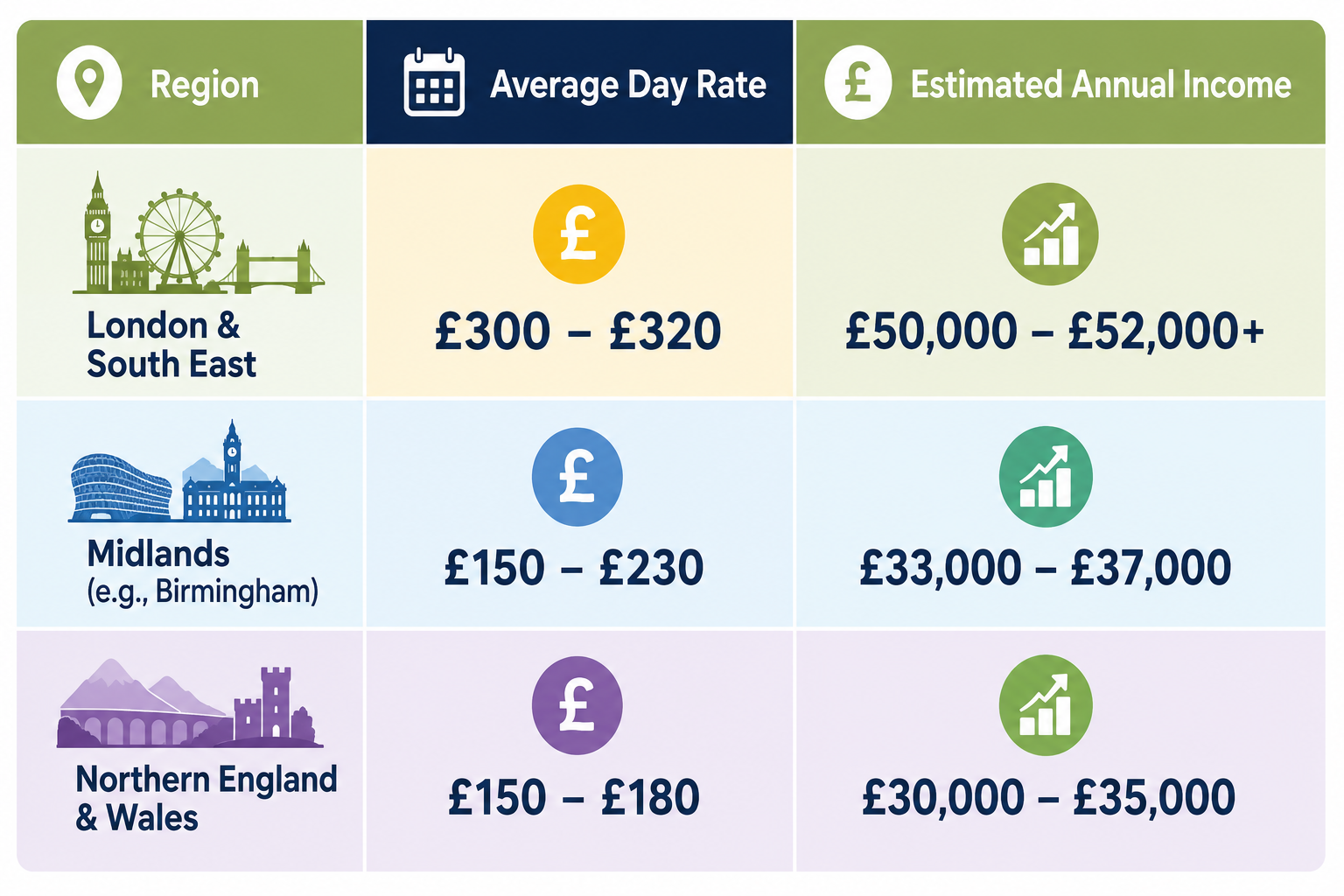
As the table shows, London and the South East lead the market, while Northern regions or parts of Wales see competitive rates starting slightly lower.
What does a bricklayer earn daily and hourly after costs?
A qualified self-employed bricklayer in the UK usually takes home around £304 to £320 per day before business costs. When you break this down into an hourly rate, a professional sole trader commonly charges about £38 to £40 an hour for their labour on-site.
However, you must remember that freelance tradespeople have to pay for their own business expenses out of this money. For example, running costs like public liability insurance, tool replacements, van fuel, and tax deductions will eat into your earnings.
So, after you deduct roughly £7,000 to £10,000 in annual business expenses, your actual daily take-home pay sits closer to £200 to £220 a day. This means your real hourly wage after all costs drops to around £25 to £28 an hour, which still beats many traditional office jobs.
How does experience change how much a bricklayer earns?
Here is how your pay rises as you gain experience in the UK trade, such as:
The apprentice stage (£17,000 to £21,000 per year)
You start by learning basic skills and safety rules on-site. Because you are still training under supervision, your pay stays lower during this initial phase.
The newly qualified stage (£30,000 to £38,000 per year)
Once you earn your NVQ Level 2, you become eligible to apply for a Blue Skilled Worker CSCS card. This qualification proves your competency, so you can work independently and secure higher starting wages.
The experienced site professional (£38,000 to £50,000 per year)
With a few years of daily practice under your belt, your speed increases. You can now take on complex, high-paying jobs like decorative facing brickwork, or you can step up to an NVQ Level 3 to get a Gold Advanced Craft CSCS card.
The self-employed or business owner ( £52,000 to £85,000+ per year)
After mastering the trade, you can leave standard employment to start freelance piecework. At this highest level, your efficiency controls your wallet because you keep the full profit from every single brick you lay.
Which factors change bricklayer pay?
Several distinct variables impact your final take-home pay on a building site. For instance, you will not always earn the same amount of money on every construction job because your daily earnings change based on your skills and your working environment.
First, your experience and qualifications play a massive role in your wages. For example, holding a Blue or Gold CSCS card unlocks access to high-paying commercial sites. Furthermore, official building trade groups set minimum hourly baselines for certified workers so that qualified professionals receive fair compensation.
Second, your daily output relies heavily on the site setup around you. If you have to deal with bad weather, poor material placement by labourers, or slow mortar mixing, it will reduce the total number of units you can place in a single shift.
Finally, job difficulty changes your pay structure. Simple blockwork allows for maximum building speed. On the other hand, decorative bonds, feature walls or historic restoration work slow down your production significantly, though they command higher premiums per unit.
What unexpected factors affect bricklayer pay?
Unexpected operational issues and site problems can cut a bricklayer’s annual income by 5% to 15% without warning.
The following hidden issues commonly reduce your daily earnings on a building site:
Weather shutdowns
Heavy rain, frost or freezing temperatures stop you from mixing mortar and laying bricks. If you work on self-employed price contracts, you do not get paid for the days you cannot work.
Material and equipment delays
If delivery trucks bring your bricks late, or if your mixing machines break down, your work will stop completely. Because you are just standing around waiting on the building site, you will work much slower. As a result, you will lose money that day.
Scaffold and lift holdups
You cannot build higher walls if the scaffolding team does not build the next platform on time. Therefore, these small delays can easily waste a few hours of your working day.
Tricky site access
Small gardens or tight spaces in the city make it very hard to move heavy materials quickly. If you have to carry bricks a long way by hand, then you will not be able to lay very many bricks before your shift ends.
Final thoughts on bricklayer earnings
Employed bricklayers in the UK usually earn between £31,800 and £40,300 a year. At the same time, top self-employed bricklayers can make over £52,000 before tax by charging daily rates up to £320. If you look at individual units, you can see how much do bricklayers make per brick because standard rates usually range from 65p to £1.50 per unit.
At the same time, job difficulty is important because specialised materials like premium clay facing bricks get much higher pay. Location also makes a massive difference, with busy areas like London and the South East paying the highest rates in the country.
To earn more money, start by getting a proper trade qualification to build your skills. Then, get your CSCS card to unlock access to bigger, better-paying commercial sites. If you want to boost your skills and increase your income potential now, you can enrol in the professional Bricklaying Training Course at Wise Campus.
FAQs
Why do bricklayers earn so much?
High demand, a severe shortage of skilled tradespeople, and physically demanding, specialised labour drive up earnings.
What is the hourly rate for a bricklayer in the UK?
The average hourly rate for a UK bricklayer typically ranges between £18 and £25.
Do bricklayers get paid 1 pound per brick?
Yes, standard machine-made and engineering bricks often pay between 65p and £1.50 per unit.
Can bricklayers make 100k a year?
Highly skilled, self-employed bricklayers working commercial price contracts can achieve six-figure annual incomes.
Can a bricklayer lay 1000 bricks a day?
Expert bricklayers can lay 1,000 bricks daily on straightforward, high-volume commercial walls.
How much does a bricklayer charge per 1000 bricks?
Bricklayers generally charge between £650 and £1,500 per 1,000 standard facing bricks.
What is the going rate for a self-employed bricklayer?
The standard daily rate for a self-employed bricklayer ranges from £240 to £320.
Do bricklayers make good money in the UK?
Yes, bricklayers earn well above the national average, especially when working self-employed piecework.
How long does it take to lay 500 bricks?
A qualified professional typically takes around five to seven hours to lay 500 standard bricks.

Bricklaying Training Course
Course Description :
- Certificate: Yes(Free)
- Accreditation: CPD Accredited
- Access: Lifetime