No products in the cart.
A chemical label can warn you about danger without using many words. These signs help workers spot risks before they touch or use a chemical. That is where COSHH symbols meaning becomes useful. It helps you understand what each warning sign is telling you. HSE officially calls these signs GB CLP hazard pictograms. They show the type of danger linked to a chemical. Meanwhile, COSHH helps workplaces control exposure and reduce harm.
So, the symbols show the risk, while COSHH helps you manage it safely.
There are 9 current pictograms, each with a red diamond border and white background. The COSHH hazard warning symbols cover explosive, flammable, oxidising, corrosive and toxic hazards. They also cover gas, health and environmental risks. Labels show signal words, hazard statements and warning statements.
This guide explains the meaning of COSHH symbols and workplace risk assessments.
What is the History of COSHH?
The UK introduced COSHH rules in 1988. COSHH means Control of Substances Hazardous to Health. These rules help protect workers from harmful substances at work. Before COSHH, different laws covered some workplace chemicals. However, workers needed clearer and stronger safety rules. So, COSHH brought these rules together in one system.
Today, employers must identify harmful substances in the workplace. They must check the risks and reduce worker exposure. They must also provide safe work methods and suitable protective equipment. Over time, the rules have changed to meet new risks. As a result, COSHH still plays an important role in workplace safety.
What are COSHH Symbols Meaning and Why Do They Matter?
COSHH symbols warn workers about chemical hazards. HSE calls them GB CLP hazard pictograms. CLP controls chemical classification, labelling and packaging. Meanwhile, COSHH controls exposure to substances that can harm health.
These chemical risk symbols can appear on chemical packaging. One chemical can have one or more pictograms. So, always read the full label for safety details. You can learn what each symbol means in the nine current COSHH pictograms.
How Many COSHH Symbols are There?
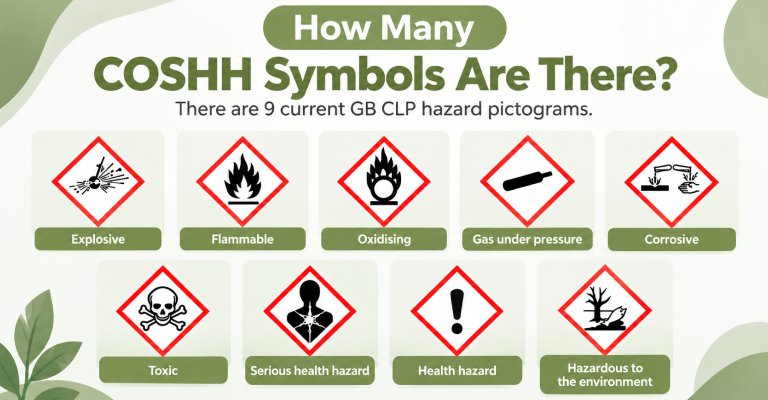
There are 9 current GB CLP hazard pictograms. People often call these COSHH symbols or COSHH symbols and meanings. The nine pictograms are:
- Explosive
- Flammable
- Oxidising
- Gas under pressure
- Corrosive
- Toxic
- Serious health hazard
- Health hazard
- Hazardous to the environment
The current system replaced older orange and black symbols. The phase-out started in 2009 and ended on 1 June 2017. The older system also used different hazard descriptions. Notably, gas under pressure has no direct old-system equivalent.
What Do the 9 COSHH Hazard Symbols Mean?
Symbol 1: Explosive
The explosive symbol shows an exploding bomb. It warns about chemicals that can explode. Some substances can cause a large explosion or strong blast. They can also throw dangerous pieces into the air. These chemicals can react to heat, fire or other ignition sources.
Fireworks can carry this hazard symbol when they are classed as explosive. So, the symbol warns about more than just fire. It also shows there can be a risk of an explosion or strong blast. Because of this, keep these substances away from heat, flames and other ignition sources. Also, always read the label and follow the safety instructions before handling them.
Symbol 2: Flammable
The flammable symbol shows a flame inside a red diamond. It means the chemical can catch fire easily. You may see it on gases, liquids, vapours, solids and sprays. Common examples include petrol, glue and solvents.
Some chemicals can give off flammable gas when they touch water. Keep these chemicals away from heat, fire, sparks and other ignition sources. Do not mix it up with the oxidising symbol. That symbol shows a flame over a circle.
Symbol 3: Oxidising
The oxidising symbol shows a flame over a circle. It sits inside a red diamond. This symbol warns that a chemical can make fires burn faster. It can also make a fire hotter. In some scenarios, it can cause an explosion. Bleach and medical oxygen are common examples.
An oxidising chemical is not the same as a flammable chemical. A flammable chemical can catch fire. An oxidising chemical can make other things burn more. So, keep it away from things that can burn. Store it in a safe place.
Symbol 4: Gas Under Pressure
The gas cylinder symbol shows a gas bottle inside a red diamond. It warns about gas under pressure. Some gases stay under high pressure inside a cylinder. As a result, heat can raise the pressure and make the cylinder dangerous. Also, the symbol covers refrigerated gases.
These gases are very cold and can cause cold burns or injuries. A damaged cylinder can also cause serious harm. This symbol had no direct old-system equivalent. You usually see it on gas containers. It warns about pressure, not toxicity. Always follow the instructions on the label.
Symbol 5: Corrosive
The corrosive symbol shows liquid falling onto a hand and a piece of metal. It warns that the chemical can cause serious skin burns and eye damage. It can also damage metal surfaces. So, contact with these chemicals can cause painful and serious injuries.
Common examples include hydrochloric acid, acetic acid and drain cleaners. These chemicals can burn the skin and eyes. This symbol means more than simple skin irritation. It warns about serious harm. Always check the label before using these chemicals. Follow the safety instructions to stay safe.
Symbol 6: Toxic
The toxic symbol shows a skull and crossbones inside a red diamond. The COSHH toxic symbol warns of acute toxicity. This means the chemical can cause serious poisoning. You can be exposed by swallowing it, touching it or breathing it in.
Some toxic chemicals can cause severe harm or even death. Examples include some pesticides, biocides and methanol. Even a small amount can be dangerous. This warning is stronger than the harmful symbol. So, always check the label before using these chemicals. Follow the safety instructions and handle them with care.
Symbol 7: Serious Health Hazard
The serious health hazard symbol shows a person with a mark on the chest. It warns about chemicals that can cause serious health problems. These effects can happen after long or repeated exposure. The symbol helps workers spot these risks before using a chemical.
It can warn about cancer, breathing problems and organ damage. It can also warn about harm to an unborn baby. Some chemicals can affect fertility too. Always read the chemical label before use. Follow all safety advice and wear the required protective equipment.
Symbol 8: Health Hazard
The health hazard symbol uses an exclamation mark. It warns about chemicals that can cause less serious health problems. These problems can affect your skin, eyes or breathing. The effects can often improve after you stop using the chemical.
The symbol can warn about skin irritation and eye irritation. It can also warn about allergic skin reactions. Some chemicals can cause drowsiness or make you feel dizzy. Always check the label and follow the safety advice before use.
Symbol 9: Hazardous to the Environment
The hazardous to the environment symbol shows a dead tree and fish. It warns that a chemical can harm the environment. The main risk involves aquatic life, such as fish and other water animals. Some chemicals can cause harm quickly, while others can cause lasting damage.
Common examples include some pesticides and biocides. Petrol and turpentine can also carry this warning. This symbol focuses on environmental harm, not only worker health. Always read the label before use. Dispose of chemicals correctly to help protect water, soil and wildlife.
What Else Appears on a Chemical Hazard Label?
A chemical label gives more than a warning symbol. It also uses two GB CLP signal words: Danger and Warning. Danger shows a more serious risk. Warning shows a less serious risk. These words help workers understand the level of danger. Hazard statements explain the harm a chemical can cause.
For example, a label may say ‘toxic if swallowed or ‘ causes serious eye damage ‘. It may also warn about long-term harm to aquatic life. Precautionary statements explain how to stay safe. They can advise eye protection or good ventilation. Suppliers usually use no more than six precautionary statements. Always read the words beside the symbol.
What Substances Does COSHH Actually Cover?
COSHH covers many substances that can harm your health at work. These substances can come as solids, liquids, dusts, fumes or gases. Some substances can cause harm after short contact. Others can cause health problems after long or repeated exposure.
- Chemicals: Cleaning products, solvents and other harmful liquids can pose health risks.
- Dusts and fumes: Fine dust, fumes, vapours and mists can damage your lungs.
- Gases: Harmful gases can affect breathing and cause serious health problems.
- Biological agents: Bacteria, viruses and other germs can cause illness and infection.
- Work-created substances: Some work processes create harmful dusts, fumes or other substances.
- Nanomaterials: Tiny particles and other harmful substances can also affect your health.
How Do COSHH Symbols Meaning Support Risk Assessments?
COSHH symbols help workers spot chemical dangers. Employers must still assess the risks. They should identify the substance and check its hazards. They should also check how workers could come into contact with it. An SDS gives useful information but does not replace the assessment.
Employers should then choose controls like ventilation, enclosure or PPE. They must review the assessment when needed. Workers also need clear safety information and training. If five or more employees work there, employers must record the main findings.
Final Thoughts
Chemical symbols give workers a quick warning about dangers. Knowing the COSHH symbols meaning helps workers understand these warnings. Always check the label before using a chemical. Follow the safety steps and wear the right PPE. Employers must also check the risks and put safety steps in place. Good COSHH knowledge helps workers stay safe when using harmful substances.
Want to learn more about chemical safety? Join our Control of Substances Hazardous to Health (COSHH) Training and build your workplace safety skills.
FAQs About COSHH Symbols Meaning
1. What are the 9 COSHH symbols and what do they represent?
- The nine COSHH symbols warn about different chemical dangers, such as fire, poisoning, corrosion and health risks.
2. What do COSHH symbols represent?
- COSHH symbols show the type of danger a chemical can cause. They help workers spot risks quickly.
3. What are the 7 main hazardous substances?
- The seven main types include chemicals, dusts, fumes, vapours, mists, gases and biological agents.
4. What are the 8 safety symbols?
- Eight common symbols warn about hazards such as fire, poisoning, corrosion, health risks and harm to the environment.
5. What are the HSE COSHH symbols?
- HSE uses the term GB CLP hazard pictograms for these chemical warning symbols. They show different types of chemical hazards.
6. What are the 9 hazard pictograms?
- The nine hazard pictograms cover dangers such as explosives, flammable substances, toxic chemicals and serious health hazards.
Control of Substances Hazardous to Health (COSHH) Training
Course Description :
- Certificate: Yes(Free)
- Accreditation: CPD Accredited
- Access: Lifetime