No products in the cart.
Do you know who identifies hidden dangers and protects people in UK buildings? The answer is simple: an asbestos inspector or a trained surveyor. But what’s the real story? Can you actually identify different types of asbestos just by looking at their shade?
In short, you cannot understand these hazardous materials by visual appearance alone. Asbestos is not one single material, but instead, it includes six recognised mineral types.
Moreover, experts group these six types into chrysotile, amosite, crocidolite, tremolite, anthophyllite, and actinolite. Most people know these minerals by their common colour names, which include white, brown, and blue asbestos.
So, let’s dive in and explore the official names, raw colours, health risks, common UK locations, and testing processes.
What Are the 6 Different Types of Asbestos?
Experts identify six main types of asbestos in industrial history. These come from natural minerals in the ground. Still, they do not all act the same way. So, experts group them into two simple types.
- Serpentine asbestos
- Amphibole asbestos
Chrysotile sits alone in the serpentine group. It is the only type in this group. On the other hand, the other five types belong to the amphibole group. These types often show up in older buildings and materials. Each type has different mineral features. Even so, the risk stays the same. When fibres break and go into the air, all asbestos types can harm your health.
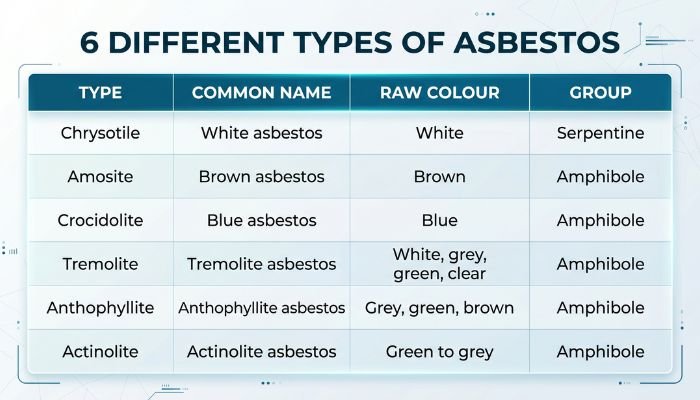
The table below breaks down the six types, their common names, raw appearances and mineral classifications.
What Is White Asbestos Called?
The official name of white asbestos is chrysotile. In its raw form, it looks white when you see it under a microscope or in a lab. It has soft, curly fibres. These fibres form in layers and sit over each other.
Because of this structure, chrysotile belongs to the serpentine mineral group. Also, people used it more than any other asbestos type around the world, including the UK.
You will commonly find it in these places:
- Cement roof sheets and rainwater gutters
- Vinyl floor tiles and backing papers
- Artex and other textured ceiling materials
- Pipe insulation wraps
- Boiler seals and high-temperature woven ropes
- Gaskets within old heating systems
- Brake products on old machinery
You must remember that white asbestos is not safe despite its softer texture. If you disturb this material, it can easily release tiny fibres into the air. People may breathe in those fibres without noticing any irritation, leading to severe internal damage over time.
Which Asbestos Types Are Often Found by Accident?
Not all asbestos was added on purpose. In many cases, it entered materials by mistake during mining. Tremolite, anthophyllite and actinolite often show up as contamination in other minerals and building products.
That is why asbestos can still surprise people today. A material may look safe, but it can still hold hidden asbestos fibres. So, the risk often comes from contamination, not planned use.
Let’s break these types down in a simple way.
Tremolite Asbestos
Tremolite is an amphibole asbestos type that often sits inside other minerals. Workers often find it mixed with talc, vermiculite insulation and some natural stone products.
Its colour can change a lot. It may look white, grey, green, brown, or even clear. Since it hides inside other materials, people often miss it during building or renovation work.
Anthophyllite Asbestos
Anthophyllite is one of the rarest asbestos types. People did not use it much on its own. Still, miners often found it as an impurity in talc mines and vermiculite deposits.
It may look grey, green, brown, or yellow-brown under light. Even though it was not widely used, it still created health risks when it appeared as contamination.
Actinolite Asbestos
Actinolite is another less common amphibole asbestos type. In its natural form, it usually looks green or grey. It also has sharp, needle-like fibres.
Sometimes, it shows up in older building materials like low-grade sealants and insulation. If these materials break or get damaged, they can release harmful fibres into the air.
What Should You Do Before Renovating an Older UK Property?
Before you start any renovation work, check when the building was built or last refurbished. This step is very important. Buildings from before 2000 are more likely to contain hazardous materials.
At the same time, do not start dusty demolition or decorating work without checking suspicious materials first. Also, avoid drilling, sanding, cutting, scraping, or breaking unknown materials during early site preparation.
To stay safe, arrange an asbestos survey before major work starts. If you find a suspicious material during the job, stop work straight away. Then, keep people away from the area until a qualified professional checks the material.
You may think, Does Asbestos Work Need a Licensed Contractor?
Some asbestos jobs are very risky. They need a licensed asbestos contractor. A job like removing amosite insulation boards or crocidolite pipe lagging needs a contractor with an official HSE asbestos licence. These materials can release dangerous fibres if someone handles them in the wrong way.
Some lower-risk jobs may not need a licence. This can include removing unbroken chrysotile cement sheets. Even so, this does not mean the job is easy. It also does not mean you should guess the risk. The work still needs a clear plan. It needs the right training, safety steps, protective clothing, and safe disposal at an authorised waste site.
So, here is the safest choice. Do not judge the material by looking at it. Do not drill, cut, break, or remove anything until you speak to a competent asbestos professional.
The rule is simple: check first, test when needed, and never disturb unknown materials.
Are All Asbestos Types Banned in the UK?
Yes, the UK has banned all new use of asbestos. This change happened step by step as health risks became clear.
At first, the UK banned blue and brown asbestos in 1985. These types caused very serious health problems. Later, white asbestos also got a full ban in 1999. However, the ban does not mean asbestos is gone. Many older buildings still contain asbestos in walls, floors and ceilings.
So today, the focus is not only removal. The main focus is safe control and proper management. In non-domestic buildings, dutyholders have legal responsibility. This can include building owners, commercial landlords, or maintenance managers. They must find asbestos risks and manage them safely all the time.
Quick Risk Map of the Different Types of Asbestos
The list below serves as a quick summary for property owners, which includes:
- Chrysotile: White asbestos. Most widely used, but not safe when disturbed.
- Amosite: Brown asbestos. Often linked with insulation and fire protection products.
- Crocidolite: Blue asbestos. Often called the most dangerous asbestos colour due to the fibre shape.
- Tremolite: Mixed colours. Often linked with contamination in talc and vermiculite.
- Anthophyllite: Mixed colours. Rare but still hazardous to human health.
- Actinolite: Green to grey. Less common but still unsafe to inhale.
This risk map helps readers compare the different types of asbestos quickly. Still, laboratory testing gives the only safe and legal answer for your property.
Final Thoughts on the Different Types of Asbestos
The different types of asbestos come with different names, colours, fibre shapes and risks. In the construction trade, people often use simple names like white, brown and blue asbestos. These names are common and easy to remember.
However, colour can still mislead you in real UK buildings. Materials often get mixed during manufacturing. So, the colour you see may not show the real asbestos type.
Crocidolite, also called blue asbestos, often gets called the most dangerous type by experts. Even so, all asbestos types can harm your health. The danger starts when fibres go into the air and you breathe them in.
So, never rely on colour, texture, age, or guesswork. If you think a material may contain asbestos in any UK property, stop work straight away. Then arrange proper testing through a certified laboratory.
Want to confidently identify workplace risks and stay fully compliant with safety regulations? Enrol in our Asbestos Awareness Training and turn guesswork into life-saving expertise.
Frequently Asked Questions (FAQs
1. What are three types of asbestos?
- The three main types are chrysotile (white), amosite (brown), and crocidolite (blue) asbestos.
2. What type of asbestos is most dangerous?
- Crocidolite, or blue asbestos, is considered the most dangerous due to its thin, sharp fibres.
3. What are the top 5 asbestos?
- The five most common types are chrysotile, amosite, crocidolite, tremolite, and anthophyllite asbestos.
4. What are the 2 classes of asbestos?
- Asbestos minerals belong to either the flexible serpentine family or the brittle amphibole family.
5. Will 30 minutes of asbestos exposure hurt you?
- Short-term exposure carries a low risk, but no amount of asbestos inhalation is entirely safe.
6. Am I in trouble if I sanded asbestos?
- Sanding asbestos releases dangerous airborne fibres; you must stop work and consult a professional.
7. Can your lungs clear out asbestos?
- No, the human lungs cannot naturally break down or clear out microscopic asbestos fibres.
8. What is the 3 5 7 rule for asbestos sampling?
- The rule dictates taking three, five, or seven bulk samples based on material surface area.
9. What is the biggest killer of asbestos?
- Mesothelioma and asbestos-related lung cancer are the leading fatal illnesses caused by asbestos exposure.

Asbestos Awareness Training
Course Description :
- Certificate: Yes(Free)
- Accreditation: CPD Accredited
- Access: Lifetime